
Stop permanent ASIO Powers.
The major parties are trying to quietly pass a law that would make extraordinary ASIO powers permanent.
These powers were introduced as temporary emergency measures. Now Labor and the Coalition want to lock them in for good, with less oversight and fewer protections.
That’s not good enough.
When governments get new powers, they rarely give them back. That’s why Australians must speak up now.
This bill would allow coercive questioning powers to continue indefinitely, even though they were meant to expire. Powers created for exceptional times should never become permanent by default.
This is where you come in.
The Senate can still stop this.
They need to hear from everyday Australians who believe freedom, fairness, and accountability matter.
Tell your senators to vote NO.
Use the tool on this page to email all your state senators in seconds.
If we stay silent, they’ll pass it.
If enough people speak up, we can stop it.
Tell Your Senators to Oppose the ASIO Amendment Bill
Enter your name and state to generate direct email links for your senators.
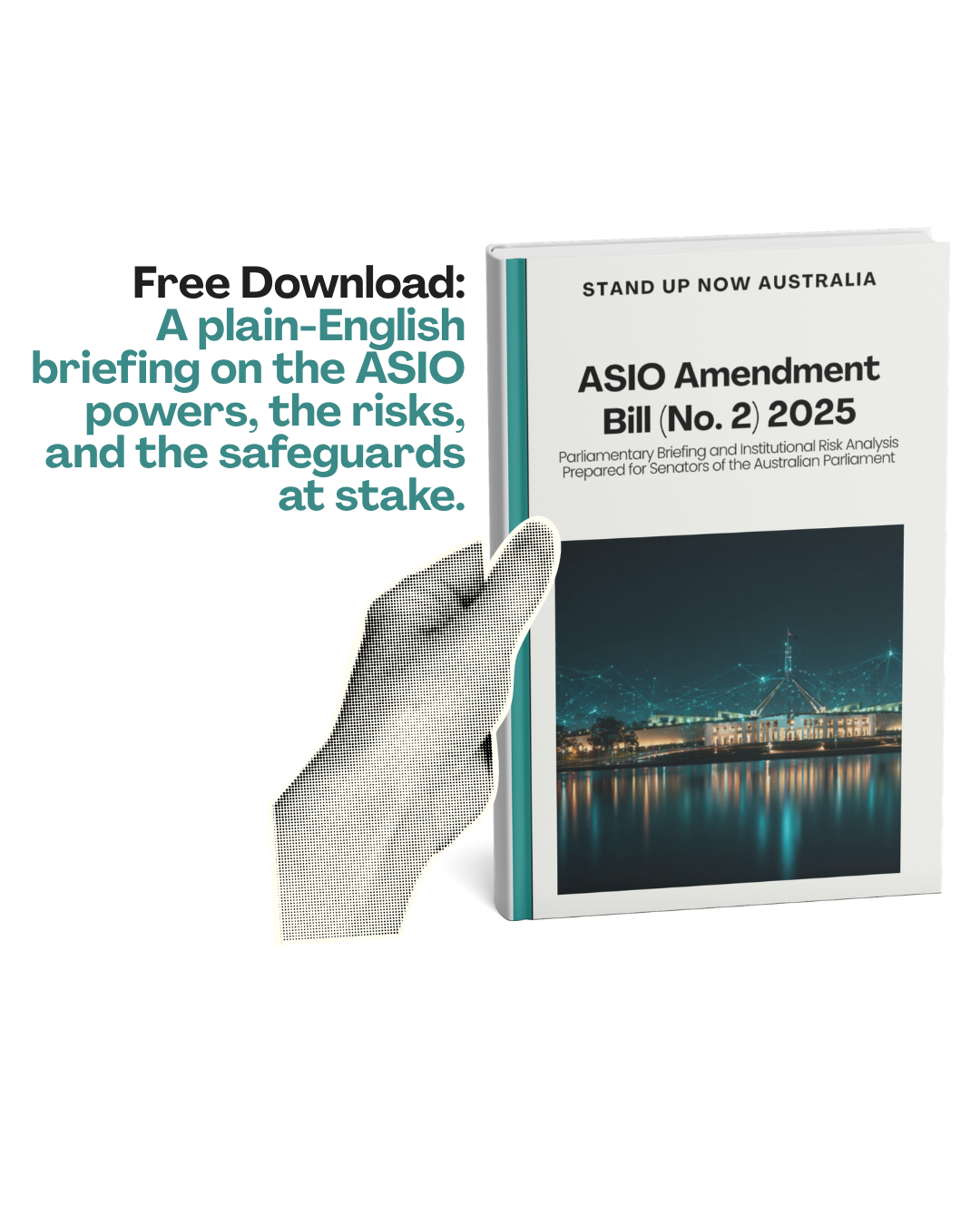
Download the ASIO Powers Briefing
Download our free briefing on the ASIO Amendment Bill (No. 2) 2025, including what the A-CDC Act changes, who it empowers, and why permanent compulsory questioning powers deserve serious public and parliamentary scrutiny. This resource is designed to help Australians understand the risks, safeguards and civil liberties questions before the Senate votes.
All Eyes On ASIO: In Conversation
In this webinar, Michael Arbon is joined by Robbie Barwick for an important discussion on the proposed ASIO amendments, the history of compulsory questioning powers in Australia, and the concerns surrounding their expansion.
This conversation provides a useful foundation for understanding the legislation now being debated in the Senate, the importance of oversight, and the broader questions these laws raise for civil liberties, democratic accountability and the rights of everyday Australians.
The Intelligence State: Where Are The Limits?
In this webinar, Michael Arbon is joined by Independent Member for Clark, Andrew Wilkie MP, for a timely discussion on Australia’s national security laws, the proposed changes to ASIO’s questioning and detention powers, and what these powers could mean for civil liberties, government oversight and democratic accountability.
Together, they explore the balance between national security and individual rights, the risks of making extraordinary powers permanent, and why informed public debate matters when legislation affects the freedoms of all Australians.

Understanding the ASIO Amendment Bill: 10 Things Every Australian Should Know
The ASIO Amendment Bill is complex, but its implications should not be hidden behind technical language.
This downloadable guide breaks down 10 key issues surrounding ASIO’s compulsory questioning powers, including the sunset clause, questioning of minors, legal representation, secrecy provisions, compulsion without charge and the proposed expansion of the framework.
Read it, share it with your community and use it to start an informed conversation about the safeguards Australians should expect when extraordinary powers are written into law.
FAQs
Has the Senate voted on the bill?
No.
The Australian Security Intelligence Organisation Amendment Bill (No. 2) 2025 passed the House of Representatives in February 2026 but remains before the Senate.
Why continue contacting Senators if the sunset clause may be retained?
Because the Senate has not yet voted and the final legislation has not been determined.
Public attention has already helped elevate the importance of the sunset clause. Continued engagement can reinforce the need to retain it and encourage Senators to support additional safeguards.
Does the bill introduce compulsory questioning powers for minors?
No.
The existing law already permits minor questioning warrants in limited circumstances for people aged 14 to 17.
However, under the new legislation, those 14 and over, can be held for 24 hours, held to secrecy over the occurrence/details of their questioning otherwise face penalties, and be subject to the same provisions surrounding legal representation.
The Senate is considering whether further changes should be made to these provisions.
Is retaining the sunset clause enough?
It is an important safeguard, but it is not the only issue.
The Senate should also closely consider the breadth of the proposed powers, the questioning of minors, access to legal representation and the independence of the oversight process.
Is the sunset clause still being removed?
The bill passed by the House wouldn’t remove the sunset clause and make the compulsory questioning framework permanent.
However, the Government, the Coalition, the Greens and numerous independents have since proposed an amendment that would no longer proceed with the repeal of a sunset clause.
Retaining a sunset clause appears to have broad support in the Senate.
The Senate has not yet voted, so the final legal position has not been settled.
What other amendments are being considered?
The Law Council of Australia has identified further proposed amendments relating to:
the compulsory questioning of minors aged 14 to 17;
provisions involving legal representatives; and
the qualifications of the authorities permitted to supervise compulsory questioning.
These issues remain subject to Senate debate.
What does a sunset clause do?
A sunset clause sets an expiry date for a law or legal framework.
If Parliament wants the powers to continue beyond that date, it must actively reconsider and renew them.
A sunset clause does not prevent ASIO from using the powers while they remain in force. It ensures that extraordinary powers return to Parliament for periodic scrutiny.
What is Stand Up Now Australia asking Senators to do?
We are asking Senators to:
retain a meaningful sunset clause;
support regular parliamentary scrutiny;
strengthen safeguards for minors;
protect access to legal representation; and
ensure robust and independent oversight.