
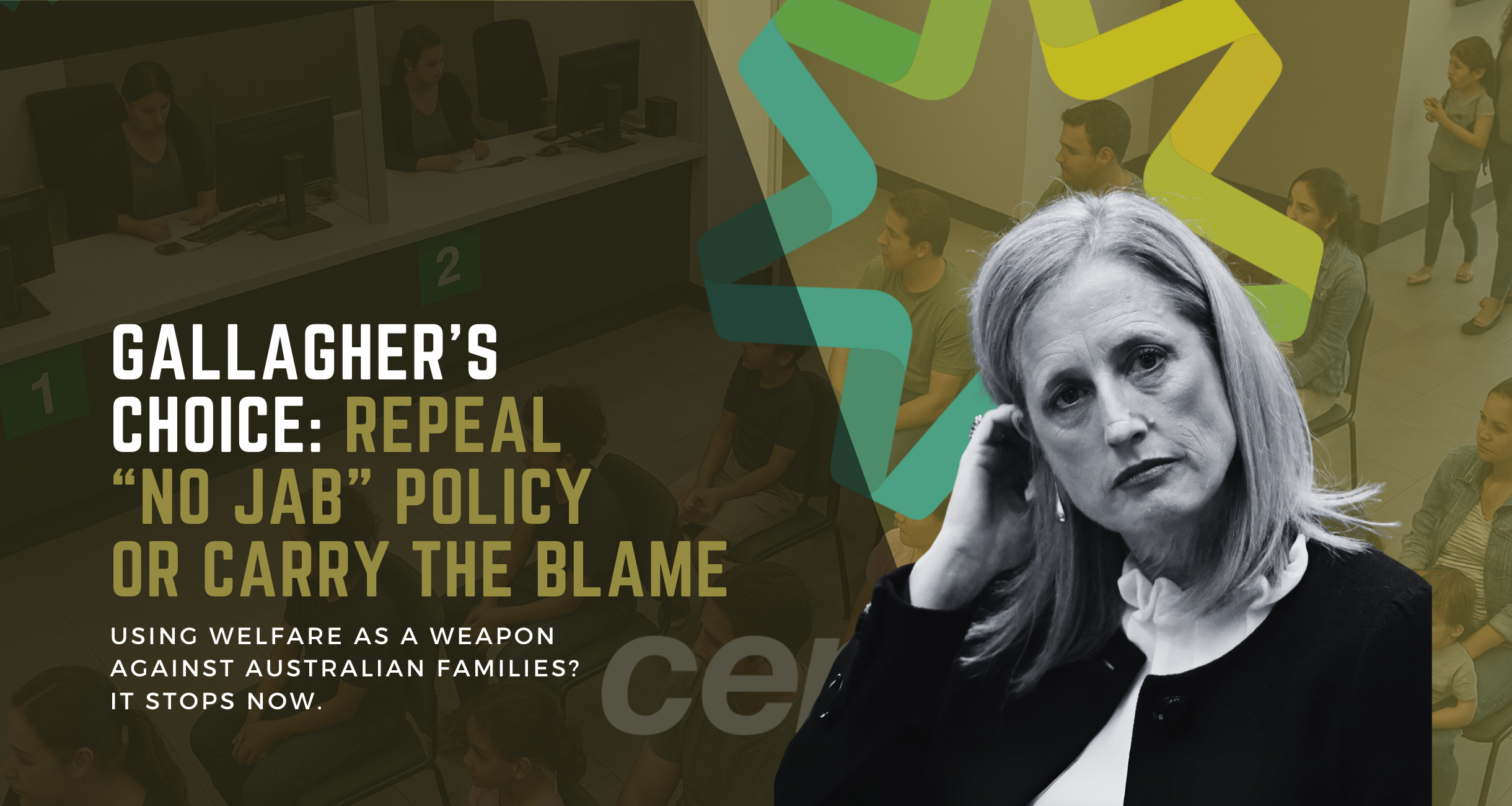
No Australian family should be punished for the choices they make about their children’s health.
When the government linked family benefits and childcare subsidies to vaccination status, they turned financial support into a tool of coercion. Instead of empowering families, No Jab No Pay creates inequality, undermines trust, and places unnecessary strain on households.
Parents lose access to childcare subsidies, forcing many out of the workforce
Grandparents and extended families pressured to provide unpaid care
Children excluded from early learning opportunities and social development
Families punished financially for private health decisions
Parents pay taxes with the promise of support. With No Jab No Pay, childcare and benefits are withheld — turning citizen rights into bargaining chips and forcing families to choose between conscience and their child’s future.
Why This Law is Wrong
How Do We Compare?
Australia is one of the only Western democracies to use welfare as a lever for medical compliance. Since 2016, the No Jab No Pay policy has tied family tax benefits and childcare subsidies to vaccination status.
By contrast:
United States: No equivalent welfare penalties. Vaccine requirements are tied to school enrolment at the state level, with exemptions in most jurisdictions (CDC – State School Vaccination Requirements).
United Kingdom: No welfare link. Vaccinations are offered through the NHS, but childcare and benefits remain unconditional (NHS Vaccinations Guide).
Canada: No federal welfare link. Some provinces (e.g. Ontario, New Brunswick) require vaccines for school entry, but families are not financially penalised (Government of Ontario – Immunization of School Pupils Act).
Australia stands apart, turning essential support into a bargaining tool, while other democracies keep welfare separate from medical choice.
The Bigger Picture
No Jab No Pay set a dangerous precedent: essential services and benefits can be withdrawn to enforce government policy. Left unchallenged, this model of coercion risks becoming the norm, eroding freedom and deepening division.
-
Once benefits are tied to vaccination, the door is opened for other behaviours — diet, lifestyle, even digital activity — to be linked to support. Welfare becomes a compliance tool, not a safety net.
-
Centrelink access already requires compliance with reporting obligations; No Jab No Pay extended this logic to health. What stops future governments from attaching conditions to housing, energy rebates, or even superannuation access?
-
Families already mistrustful of government feel silenced, not engaged. For example, parents choosing a slower vaccine schedule are lumped in with “non-compliance,” losing benefits despite partial uptake.
-
Wealthy families can absorb childcare costs; single-parent households cannot. This effectively punishes children for their parents’ medical decisions.
For rural families, where childcare options are scarce, losing subsidies can mean no access to early education at all.
Stories That Cut Through
FAQs
Why is No Jab No Pay a political problem, not just a health policy?
Because it redefined welfare as a tool for compliance rather than a safety net. Instead of supporting families equally, the government turned tax-funded entitlements into a weapon of enforcement. It sends the message that benefits are conditional on obedience, not citizenship.
Isn’t this just about encouraging vaccination?
No. Australia already had one of the highest vaccination rates before this policy was introduced. No Jab No Pay was never about boosting uptake, it was about signalling political toughness and winning votes at the expense of vulnerable families.
How does this policy punish children?
Children are excluded from early learning and care, not because of neglect, but because their parents made a different medical decision. This is collective punishment. It removes a child’s right to participate in education and social development, while also stripping parents of the freedom to choose the care arrangement that best suits their family.
Options like co-ops, au pairs, or community childcare are pushed aside in favour of a one-size-fits-all system enforced through subsidy rules. The result is fewer choices for parents, less stability for children, and deeper inequality across generations.
How does Australia compare internationally?
We stand virtually alone. Other democracies encourage vaccination but do not strip parents of childcare subsidies or family benefits. By linking welfare to medical compliance, Australia chose to isolate itself and to double down on coercion where others chose education and consent.
Who really pays the price for No Jab No Pay?
It is not the wealthy, who can afford private childcare and forego subsidies. It is working families, single parents, and low-income households who are forced to comply because the financial penalty is devastating. This policy entrenches inequality and punishes the people least able to carry the burden.
Why does this matter beyond vaccination?
Because the precedent has been set that essential services can be withdrawn to enforce government policy. Today it is childcare subsidies. Tomorrow it could be other payments, housing support, or digital access. Once coercion is normalised, it spreads.