
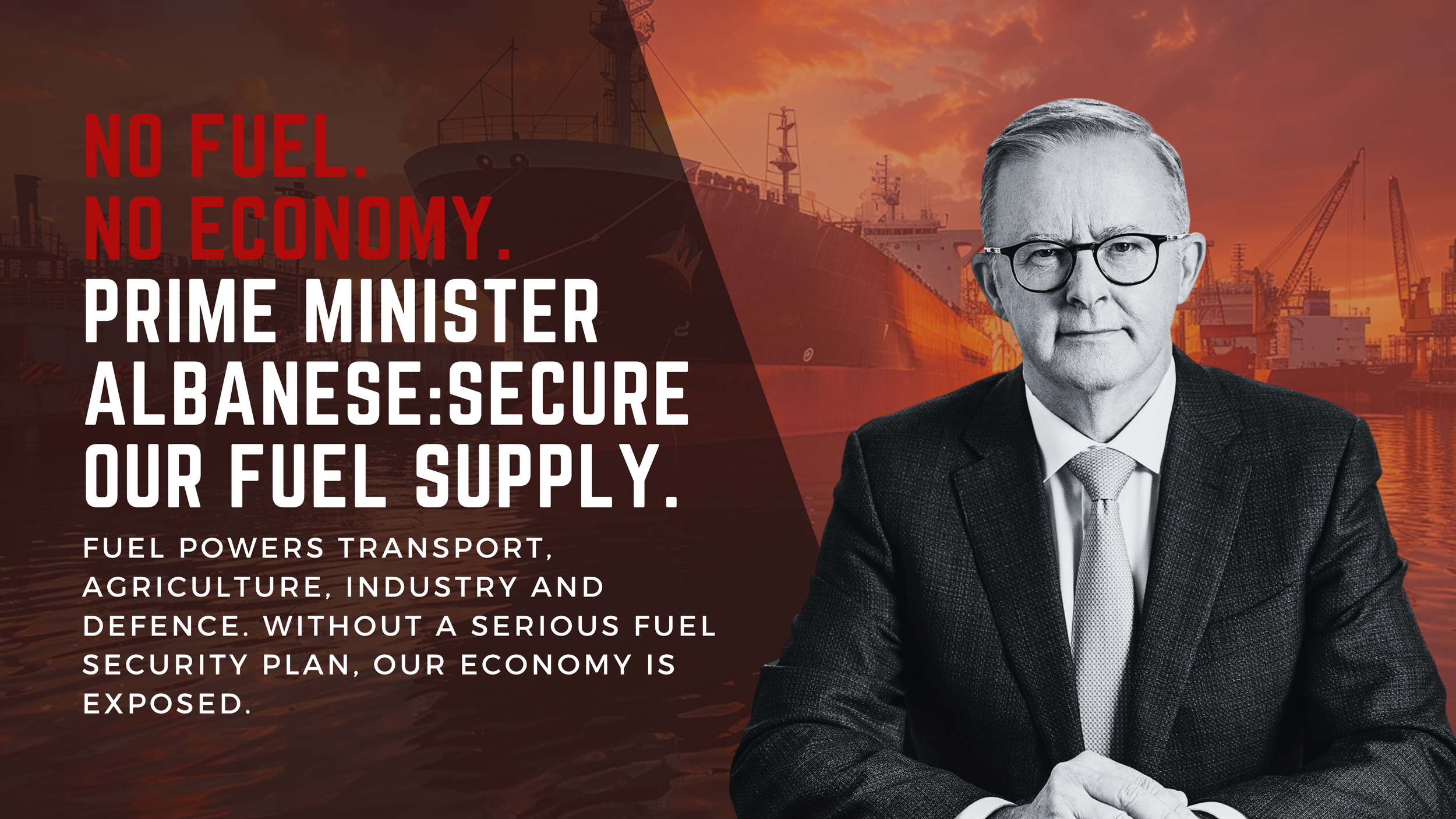
At a time of rising global instability, Australians are paying higher prices while our national fuel resilience weakens.
This is not sustainable.
What’s being created and why it matters
Australia depends on fuel to keep the country running; from farms and freight to aviation and everyday transport. Yet today Australia imports the vast majority of its fuel and holds far less emergency supply than international standards recommend.
Fuel affects almost every part of the Australian economy:
• food production
• freight and supply chains
• aviation and tourism
• emergency services
• household budgets
When fuel prices surge, the cost flows through the entire economy.
Australia should take this opportunity to strengthen its resilience — not weaken it.
The issue explained
-
Fuel supports many core parts of the Australian economy.
It powers agricultural machinery during planting and harvest seasons, enables freight movement across long distances, supports aviation and tourism, and underpins everyday transport for households and businesses.
Changes in fuel prices affect a wide range of economic activities. Higher fuel costs can increase freight expenses, raise input costs for agriculture and industry, and contribute to higher prices across supply chains.
Because Australia is a geographically large country with long transport distances, fuel costs influence economic activity across many sectors.
-
Australia imports most of the refined fuel it consumes.
Around 80–90% of Australia’s petrol, diesel and aviation fuel is refined overseas before being shipped to Australian ports.
Much of this refining occurs in major international refining hubs such as Singapore, South Korea and Japan.
This system relies on global shipping routes and international refining capacity. While these supply chains can operate efficiently during stable periods, they are also exposed to disruption during periods of geopolitical tension, shipping interruptions or broader market volatility.
-
Australia once maintained a far stronger domestic refining industry.
During the latter half of the twentieth century, Australia operated eight oil refineries across the country.
Over time, economic pressures and global industry shifts led to refinery closures.
Today only two refineries remain operating.
This significant reduction in refining capacity means Australia now relies far more heavily on imported refined fuel than it did in previous decades.
-
Fuel reserves are used by many countries to provide a buffer during supply disruptions.
Australia currently holds approximately 30–36 days of fuel reserves.
International benchmarks commonly referenced by advanced economies are closer to 90 days of reserves.
The difference between these levels reflects a lower margin of supply protection if international shipments are delayed or disrupted.
-
Fuel costs affect a range of economic activities beyond household transport.
Higher fuel prices can influence:
• freight and logistics costs
• agricultural production and food distribution
• construction and industrial activity
• aviation and tourism
• operating costs for many businessesBecause fuel is used throughout supply chains, price increases can flow through to goods and services across the broader economy.
What we are asking for
We call on the Australian Government to act immediately:
Temporarily suspend fuel excise during the current supply crisis: Australians currently pay 52.6 cents per litre in fuel excise. Temporary relief would immediately reduce cost pressures across the economy.
Suspend GST on fuel during the crisis: GST is applied after excise, meaning Australians pay tax on tax, during periods of supply shock, this additional burden should be removed.
Prioritise domestic fuel supply: Australia must ensure locally refined fuel serves domestic demand before export during supply instability.
Rebuild sovereign refining capacity: Australia once operated eight refineries. Today only two remain. A clear long-term plan is needed to restore and modernise domestic refining capability.
Establish domestic contingency fuel capability: Australia should rapidly develop locally derived fuel options to ensure supply resilience during global disruptions.
We are urging The Albanese Government to exercise fiscal responsibility.
Tax relief now cannot become tax burden later.
If government revenue is reduced, government spending must be reduced accordingly.
Anything less simply shifts the cost onto future Australians through debt or higher taxation.
FAQs
What is actually changing on 1 January 2026?
The Australian Centre for Disease Control Act 2025 will begin. From that date Australia will have a permanent federal CDC, led by a Director-General who is appointed by the Health Minister. This body will have its own legal powers to request or require health information from Commonwealth agencies, States, health services and some private entities. It will also be able to authorise how that information is shared. That is a step up from the temporary, cooperative model we saw through COVID, because this one is ongoing and set out in legislation.
Can the ACDC really override other laws?
In many cases, yes. Section 70 of the Bill says that authorisations and directions under the CDC Act have effect “despite any other law of the Commonwealth, a State or a Territory”. That wording matters. It means that if the CDC issues a lawful direction to get information, normal privacy settings, State health-record protections or confidentiality rules can be pushed aside. Only a small group of secrecy laws remain out of reach. This is one of the most significant parts of the Bill because it shifts the usual order of things. Instead of privacy being the default and public health asking permission, public health can act first and privacy follows.
What are “data-sharing declarations” and why are they a problem?
Sections 67 to 69 allow the Director-General to issue a data-sharing declaration if there is a “severe or unforeseen threat to public health”. Once that declaration is made, information can be collected and shared for up to 12 months to deal with that threat. The problem is not that emergencies can be managed. The problem is that these declarations are not disallowable by Parliament. In other words, once the Director-General turns this on, the people you elected in Canberra cannot vote it down. That is a structural gap in democratic oversight. It also creates a strong incentive to define situations as “threats” in order to unlock the wider data powers.
Can the CDC make deals with overseas or global bodies without Parliament?
Yes. Section 13(3) allows the CDC to enter arrangements with foreign governments, international organisations, and international public–private partnerships. Section 24 says there must be a register of those arrangements, which sounds transparent at first. However, it also allows the Minister to withhold information from that register if publishing it would harm international relations or public confidence, or if the information was provided confidentially. That means Australians could find out that an arrangement exists, but not see what was agreed. This is a real concern in a context where the same CDC can also move health data around.
Where is Parliament in all this? Isn’t there oversight already?
Parliament is present in a light-touch way. The CDC will produce annual reports, it will be subject to the PGPA Act, and it can be questioned at Estimates. There is also a five-year review clause. What is missing is real-time parliamentary control over the most powerful parts of the Act. Parliament cannot disallow data-sharing declarations. Parliament does not have to approve international arrangements. Ministerial directions to the CDC do not have to be tabled. That is why we are calling for a standing parliamentary oversight committee and for tabling and disallowance of the most intrusive powers.
Can individuals still “opt out” like they can with some health registers?
People should still use every opt-out, privacy and “no secondary use” option available to them. Those tools still matter in day-to-day health administration. However, under this Act, if the CDC validly issues a direction under sections 44–46 and that direction is supported by section 70, personal opt-out settings can be overridden. In simple terms, individual protections remain useful in normal conditions, but they are not a hard shield once the CDC has used its statutory powers. That is why the real fix has to come at the level of Parliament, not just at the level of patients and families.
Could this be used for things other than disease?
Yes. The Bill’s definition of public health and health protection is wide. It can include environmental health, climate-related health impacts, and preventive health. That means the CDC could justify information collection for programs that are not about an outbreak, for example, to monitor compliance, to model population behaviour or to assess uptake of a national health measure. Once the system is in place, it can be used for more than people first imagined. This is a classic “mission creep” risk, which is why earlier and stronger oversight is important.
So what is the actual risk to ordinary Australians?
The biggest risk is loss of control over who sees your health information and for what purpose. A second risk is that Australia normalises executive-led, not Parliament-led, health governance. A third risk is that international bodies gain influence over Australian public-health settings without public debate. None of these things happen loudly. They happen through rules, registers and directions that most people never see. Once normalised, they are very hard to wind back.