
Are South Australia’s systems delivering the best results for the people they serve?
Every government is entrusted with the same responsibility: to organise systems that deliver the best possible outcomes for the people who rely on them.
In South Australia, outcomes across key systems — the economy, healthcare, housing, energy, and regional services — continue to fall short of that standard for many people.
These outcomes are not abstract. They shape whether families can access care on time, whether households can absorb rising costs, and whether communities remain viable over the long term.
This page sets out how South Australia’s systems are functioning in practice — and where results consistently fail to match expectations.
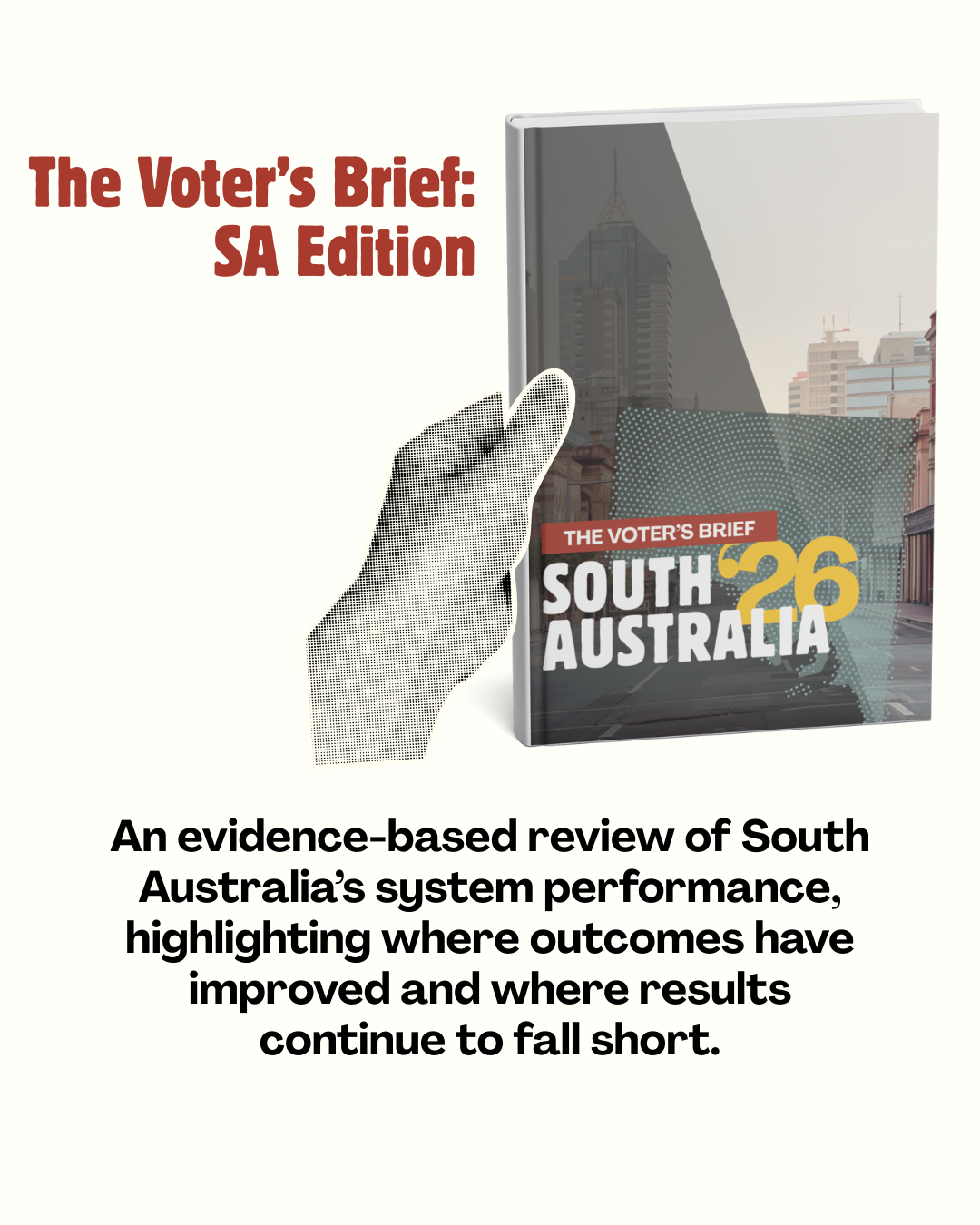
How South Australia’s Systems Are Performing
-
What kind of economy has South Australia built — and what does it return to households?
South Australia’s largest employment sectors are funded by government spending, while its major wealth-creating sectors employ fewer people and receive comparatively less policy focus.
This matters because jobs that circulate existing money cannot, on their own, raise incomes or build resilience when costs rise. Over time, this structure produces slower wage growth, limited private investment, and higher dependence on federal transfers.
The question is not whether these sectors are valuable — it is whether the overall structure is delivering strong, durable outcomes for households.
👉 The economic structure and its long-term effects are examined in detail in the SA Election Brief.
-
Why do rising costs hit harder in South Australia than elsewhere?
South Australia combines relatively low household incomes with some of the highest electricity costs and tightest rental conditions in the country.
When incomes grow slowly and essential costs rise quickly, households have less capacity to absorb shocks. Planning constraints, infrastructure decisions, and regulatory settings shape these outcomes long before prices appear on a bill.
Cost-of-living pressure is not just about prices — it is about the system’s ability to give people room to move.
👉 The income–cost mismatch is analysed in the SA Election Brief.
-
What does record ambulance ramping say about system design?
South Australia has consistently recorded the highest per-capita ambulance ramping in the country.
Ramping at this scale is not a temporary surge problem. It signals a system where emergency demand, hospital capacity, and patient flow are misaligned. Regional service reductions have further concentrated pressure into metropolitan hospitals.
When access to urgent care becomes unpredictable, the system is no longer performing its core function.
👉 Health system performance and service changes are examined in the SA Election Brief.
-
How are regional communities affected by current system settings?
Regional South Australia supports key export industries but has experienced declining access to services, workforce instability, and population loss in many areas.
FIFO-dominant project models and population-based funding have reduced long-term local employment and weakened service provision. These settings shift pressure toward metropolitan centres and reduce statewide resilience.
The outcome is declining regional viability with broader economic and social consequences.
👉 Regional impacts are detailed in the SA Election Brief.
-
Have outcomes improved in proportion to time and authority?
South Australia has alternated between Labor and Liberal governments for decades.
Across this period, key indicators — including income levels, health system performance, and regional service access — have shown limited sustained improvement. This raises questions about system design, priority setting, and delivery capacity.
Assessing performance requires examining outcomes over time rather than individual terms or announcements.
👉 Long-term governance and outcome analysis is published in the SA Election Brief.
The People’s Contract
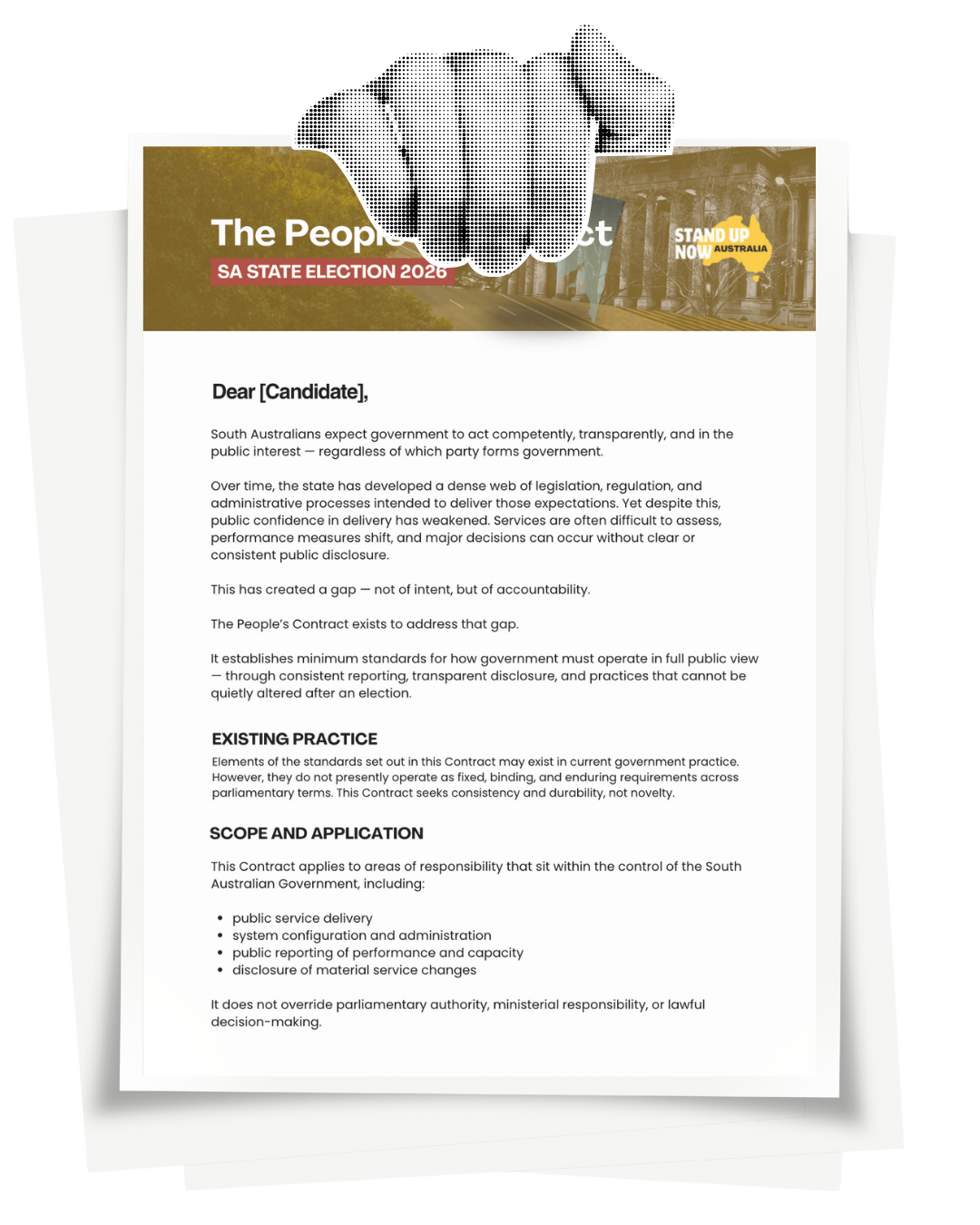
The People’s Contract sets out a small number of standards for election commitments.
It focuses on whether claims are clear, within the powers of state government, and open to being tested after the election.
The Contract is not a policy platform. It does not tell anyone what to support, and it does not rank parties or candidates.
It provides a common reference point for assessing what is being promised, how it is meant to work, and what it is intended to affect.
A set of standards you can take to your local candidate.
Understanding the South Australian State Election

What’s on the ballot. What’s at stake. What your vote actually influences.
South Australia votes soon.
Beyond headlines and campaign slogans, what does a state election actually decide? What powers does the state government control? And how can voters assess commitments with clarity?
Hosted by Stand Up Now Australia as part of our SA Election 2026 public information series, this discussion brings together three voices from economics, law, and public policy to explore how current settings affect South Australians
— and what questions voters should be asking ahead of election day. The conversation also considers whether South Australia reflects, in micro, the broader macro trends shaping Australian politics.
Featuring:
Joanna Howe, legal academic specialising in constitutional and legislative frameworks, on how state and federal powers intersect.
Professor Gigi Foster, economist and public policy expert, on incentives, institutional design and long-term policy outcomes.
Michael Arbon, business leader and former South Australian parliamentarian, on how decisions are made inside Parliament and how economic realities shape legislation.
Whether you feel engaged or uncertain, this session aims to equip you with clarity and perspective ahead of the vote.
Quick Pitch

An open invitation to candidates. Equal time. Direct to voters.
Stand Up Now Australia is inviting declared South Australian state election candidates to submit a ninety second video outlining their priorities and approach.
Each participant receives the same time and the same format.
No debate.
No commentary.
No endorsements.
Submissions will be published here, in one place for transparent comparison.
We are currently accepting entries.
FAQs
Is South Australia’s economy actually weaker than other states?
South Australia has one of the lowest median household incomes in Australia, ranking ahead of only Tasmania, despite facing similar or higher living costs
The state also has a narrow economic base, relying on a small number of wealth-creating sectors while maintaining a large public sector workforce.
This combination contributes to slower wage growth and lower household resilience over time.
Why does South Australia rely so heavily on federal funding?
South Australia’s largest employment sector is health, which is funded primarily through state budgets and Commonwealth transfers.
While essential, this sector does not generate new income for the state.
Wealth-creating sectors such as agriculture, resources, defence manufacturing, international education, and tourism employ fewer people but underpin the state’s revenue base. When these sectors are limited in scale, reliance on external funding increases.
Is ambulance ramping in South Australia really worse than elsewhere?
Yes.
South Australia consistently records the highest ambulance ramping hours per capita in Australia.
In August 2025 alone, ramping reached 5,284 hours — one of the worst months on record.
This is not an isolated event. The data shows a persistent pattern over multiple years.
Why does regional hospital capacity affect Adelaide hospitals?
Many regional hospitals have lost emergency departments, birthing services, or specialist staffing.
As a result, patients who would previously have been treated locally are transferred to metropolitan hospitals. This increases demand on Adelaide emergency departments and contributes directly to ambulance ramping and bed block.
What is the purpose of publishing this information now?
The purpose is to allow voters to assess whether outcomes in South Australia have improved in proportion to time, authority, and public investment — ahead of the election.
This information is provided so claims and promises can be evaluated against established results.
Why are cost pressures felt more sharply in South Australia?
South Australia combines:
Low median household income
High electricity prices
A small and rigid rental market with very low vacancy rates
When income growth is limited and essential costs are high, households have less capacity to absorb increases or respond to disruption. These conditions are structural and long-standing.
Do regional areas really generate most of South Australia’s wealth?
Yes.
Agriculture, mining, energy, and other resource-based industries — largely located in regional areas — generate a significant share of South Australia’s export income and real economic value.
Despite this, regions often receive less investment and fewer services due to population-based funding models.
What impact does FIFO work have on regional communities?
More than 100 major mining and quarry projects in South Australia rely on FIFO workforces.
While economically efficient for operators, FIFO models reduce local employment, limit population growth, and weaken the long-term viability of regional towns. This contributes to service withdrawal and community decline.
Have these issues emerged under one government?
No.
South Australia has been governed by both Labor and Liberal parties over several decades.
Many of the pressures identified — low income growth, health system strain, regional service decline — persist across multiple terms and governments.
The data suggests long-running structural patterns rather than short-term political events.
Where does the information on this page come from?
All information summarised here is drawn from:
Publicly available government data
Official reporting
Long-term trend analysis
Full sources, data tables, and methodology are published in the SA Election Brief.