
Australia Cannot Redistribute Wealth It No Longer Creates
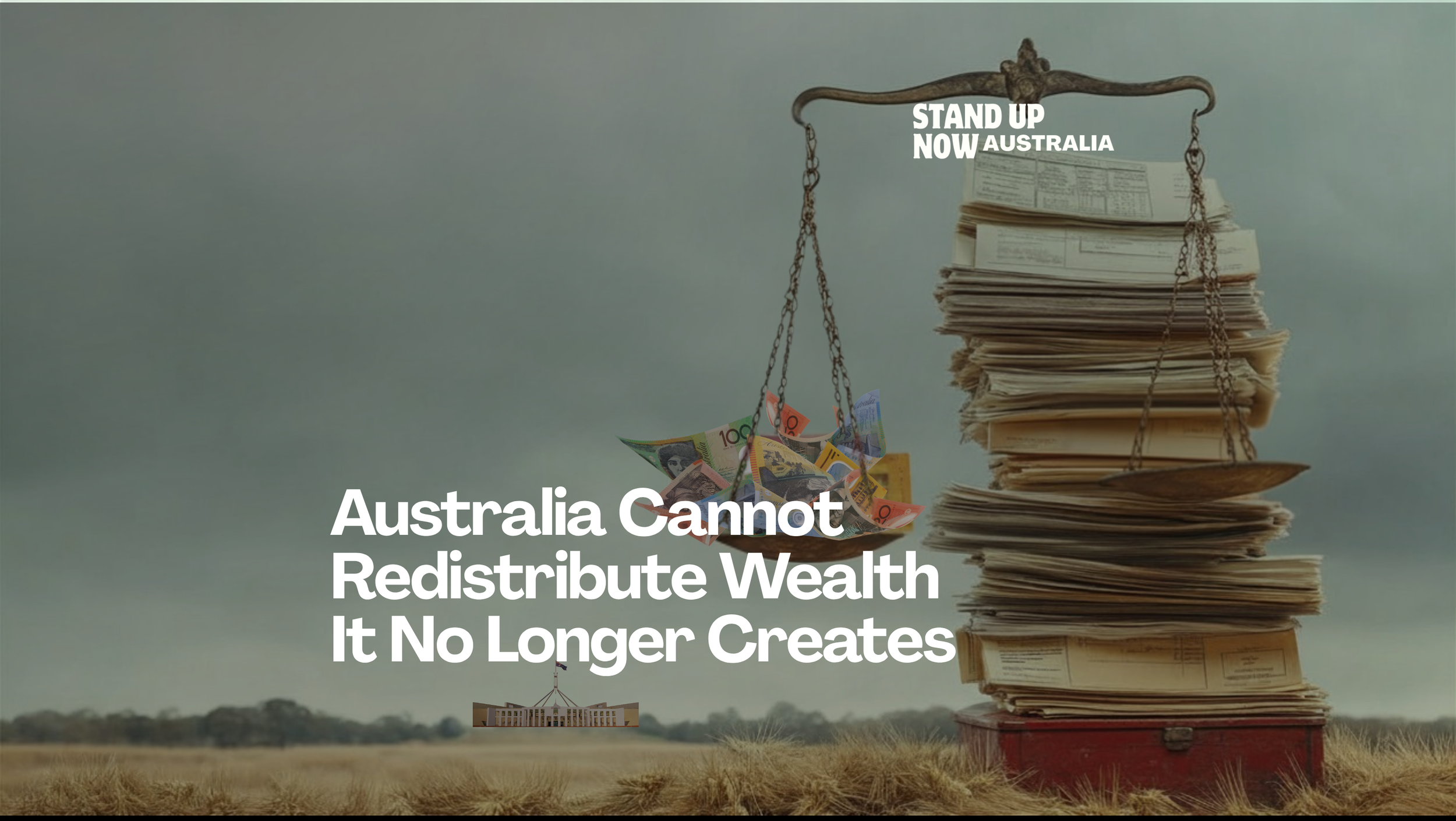
Australians are increasingly feeling like every wealth creating avenue left in this country is being targeted at once.
Property investors.
Small business owners.
Families using trusts.
People trying to build retirement savings.
Australians who have spent decades working, saving, investing and attempting to create some level of financial security for themselves and their children.
This Budget has intensified that feeling.
Much of the public debate has focused on proposed changes to capital gains tax, negative gearing, family trusts and superannuation taxation. Individually, each measure is being defended as “targeted reform” or “budget repair”.
But Australians are not reacting to these policies individually anymore.
They are reacting to the pattern.
Taken together, these measures paint a much bigger picture:
a Government increasingly reliant on taxing productivity, investment and private wealth creation — taking more from those generating economic activity in order to redistribute it through an expanding public sector — while showing very little willingness to restrain its own bureaucracy, spending or size.
That is the real issue emerging from this Budget.
Not simply taxation.
Not simply housing.
Not simply superannuation.
But the direction of the country itself.
At what point does a nation stop encouraging enterprise, investment and productivity and begin penalising them?
That question sits underneath much of the public frustration Australians are expressing right now.
While Australians are being asked to absorb higher costs, heavier taxation and declining living standards, there appears to be little appetite in Canberra for meaningful restraint in government expansion.
Public-sector employment growth has recently outpaced population growth, government spending continues to rise, and increasingly large parts of the economy now rely directly or indirectly on taxpayer-funded activity.
Meanwhile, many of the industries that actually generate national wealth — construction, manufacturing, agriculture, mining, small business and investment — face growing pressure from taxation, regulation, energy costs and economic uncertainty.
That imbalance raises serious long-term questions about the sustainability of Australia’s economic direction.
Government spending continues to grow.
Debt continues to rise.
Entire new layers of administration, compliance and wealth transfer continue to emerge.
Yet when budget pressures intensify, the proposed solution almost always appears to be the same:
extract more from the productive economy.
And that should concern Australians regardless of political affiliation.
Because governments do not create wealth.
The private economy does.
Businesses create jobs.
Farmers produce food.
Tradespeople build homes.
Entrepreneurs take risks.
Investors allocate capital.
Workers create value.
The public sector is funded by the success of the private sector — not the other way around.
Without a productive economy generating wealth, there is nothing to redistribute.
And yet increasingly, Australia appears to be drifting toward an economic model focused less on creating prosperity and more on reallocating it.
That shift matters. Redistributing existing wealth may temporarily relieve pressure. But it cannot replace production.
Subsidies cannot replace innovation.
Rebates cannot replace productivity.
Government dependency cannot replace national capability.
Historically, Labor governments have understood this reality.
The Hawke and Keating governments pursued controversial economic reforms because they recognised that long-term prosperity required private enterprise and wealth creation, competitive industry and fiscal discipline. They understood that government could not endlessly spend beyond the productive capacity of the economy.
Paul Keating’s famous ‘banana republic’ warning in the 1980s was ultimately about economic complacency; a warning that nations which fail to remain productive, competitive and economically disciplined eventually decline.
Whether Australians agreed with every reform or not, those governments at least understood a fundamental principle: wealth must first be created before it can be redistributed.
That principle increasingly feels absent today.
Modern political debate has become dominated by redistribution politics:
who gets what,
who pays more,
what subsidy can be offered,
what rebate can be announced,
what new program can be created.
Meanwhile, the harder national questions are often ignored.
Why is productivity stagnating?
Why are energy costs crippling industry?
Why is housing becoming unattainable for younger Australians?
Why are small businesses drowning in regulation and compliance?
Why does Australia, one of the most resource-rich nations on Earth, increasingly struggle to manufacture even basic goods competitively?
Australia was once regarded as one of the most capable and self-reliant societies in the world.
We built industries.
We manufactured products.
We refined fuel.
We processed resources.
We produced things domestically.
We rewarded enterprise and risk-taking.
Australians became globally respected for the standard of living they created through ingenuity, hard work and practical capability.
Yet today, despite extraordinary natural wealth and resources, Australia increasingly struggles to manufacture even basic goods competitively.
We export raw materials and re-import finished products.
We rely heavily on overseas manufacturing and supply chains.
We have watched major domestic industries decline while layers of administration and compliance continue expanding.
And instead of aggressively rebuilding productive capacity, modern political debate increasingly revolves around redistribution:
who receives assistance,
who qualifies for rebates,
which group receives relief,
and who should be taxed further to fund it.
That is not a long-term national economic strategy.
While redistribution may temporarily ease pressure, it does not rebuild productivity, national capability or economic resilience.
Only production, investment and innovation can do that.
This was a country known for builders, manufacturers, miners, farmers, inventors and entrepreneurs. Australians were admired globally for their independence, resilience and practical capability.
Now increasingly, we are becoming a country that imports what it consumes, taxes what it produces and expands the bureaucracy managing the decline.
Even culturally, something deeper appears to be shifting.
Australians are increasingly being conditioned to look toward government for relief, support, rebates and intervention at every stage of economic life.
And while support mechanisms absolutely have a place in society, there is a profound difference between a safety net and systemic dependency.
One empowers recovery, the other normalises reliance.
A confident nation encourages its citizens to build, innovate, invest, create and take risks.
A declining one increasingly manages economic contraction through redistribution.
That is why this Budget has struck such a nerve.
Because many Australians no longer feel they are being encouraged to get ahead.
They feel they are being managed.
Through taxation, subsidies, compliance, and redistribution.
All while government itself continues expanding with remarkably little discussion about restraint, efficiency or reduction in spending.
Younger Australians are inheriting an economy where housing is less attainable, entrepreneurship is harder, energy is more expensive and taxation continues expanding — all while government dependency steadily grows.
And ultimately, this is the contradiction at the centre of the modern Australian economy:
The more government grows, the more revenue it requires.
The more revenue it requires, the harder it leans on the productive economy.
And the harder it leans on the productive economy, the weaker productivity, investment and private-sector confidence can become over time.
That is not a sustainable cycle.
Because no nation can endlessly tax, regulate and redistribute its way to prosperity.
And no country can redistribute wealth it no longer creates.
That is not the Australian promise previous generations inherited, because no nation can endlessly tax, regulate and redistribute its way to prosperity.
And no country can redistribute wealth it no longer creates.