
Remember the A-CDC? Ask the penguins.
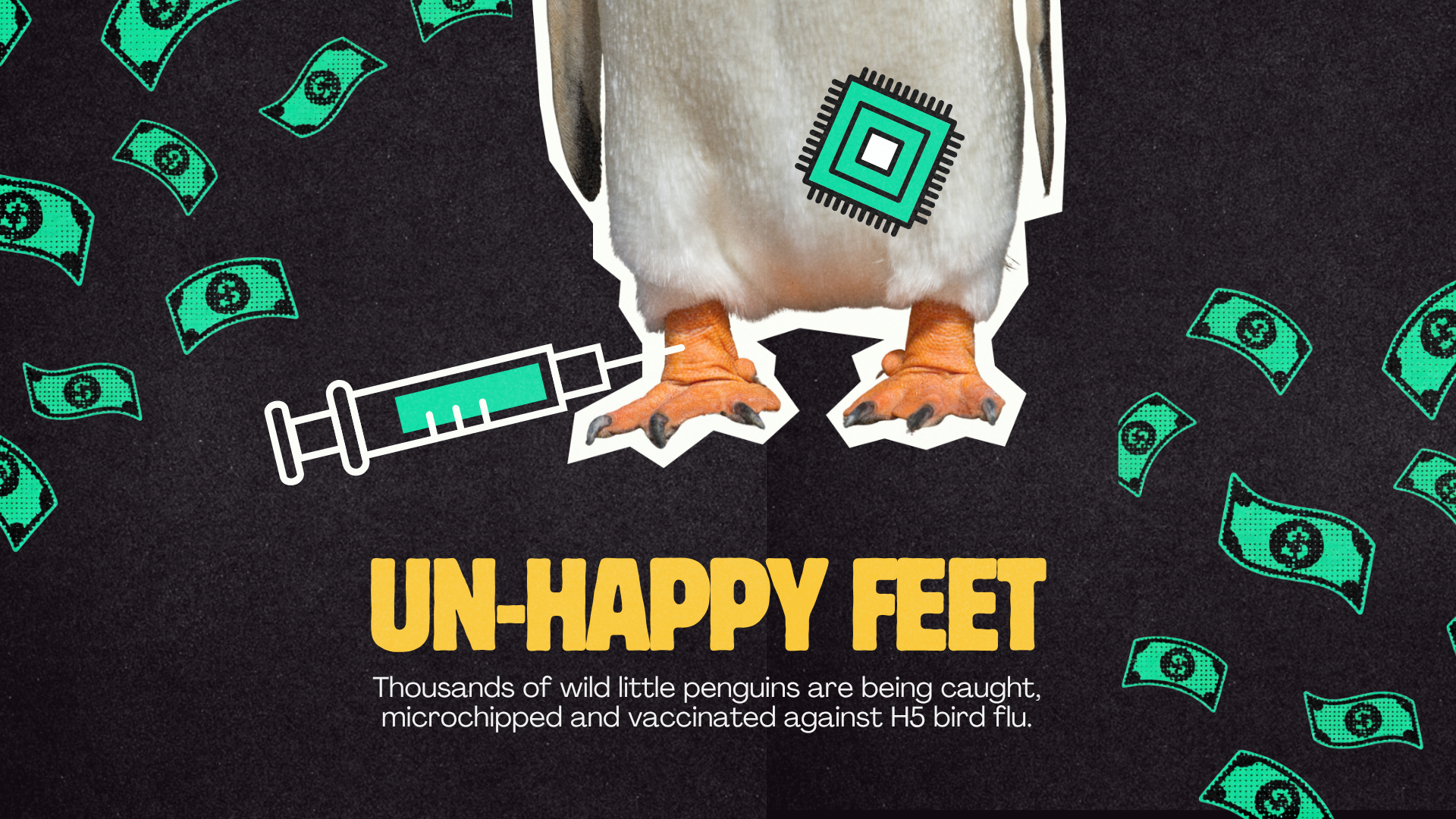
You may have seen the extraordinary images coming out of Victoria: wild little penguins being captured, checked, microchipped and vaccinated against H5 bird flu.
It is an unusual sight, and for many Australians the immediate question has been simple:
Why are we vaccinating wild penguins?
There is a much bigger story here.
What is happening on Phillip Island does not begin with a penguin, a syringe or even the arrival of H5N1 in Australian wildlife.
It sits within a much larger system of disease surveillance, pandemic preparedness, animal and human health policy, pharmaceutical development and international cooperation that Australia has been building for years.
And if you read our investigation into Australia's new Centre for Disease Control earlier this year, some of it may sound very familiar.
Remember the A-CDC?
Back in January, Stand Up Now Australia launched our investigation into Australia's newly legislated Australian Centre for Disease Control (A-CDC).
Our 53-page report, Bureaucracy in the Bloodstream, examined the extraordinary powers and information-sharing architecture surrounding the new agency, but it also looked at something broader: the A-CDC's place within an increasingly interconnected international system of disease surveillance and pandemic preparedness.
Central to that system is One Health.
One Health is an international approach, now jointly advanced by the WHO, FAO, UNEP and World Organisation for Animal Health, based on the idea that human health, animal health and environmental health are interconnected and should therefore be considered together when identifying and responding to health threats.
At one level, that proposition might not sound controversial. Diseases can move between animals and humans. Environmental conditions can influence disease. Monitoring animal populations can provide information about emerging threats to people.
But once that principle becomes embedded in government institutions, international agreements, surveillance systems and emergency-response frameworks, its reach becomes significant.
The health of wildlife is no longer simply a wildlife-management issue.
It becomes part of the broader machinery of public health and pandemic preparedness.
That is why we paid attention when we discovered that Australia's interim CDC had already established a One Health Unit and was supporting preparations for a potential outbreak of H5N1 avian influenza.
At the time, H5N1 had not been detected in Australian wildlife.
Now it has.
And the machinery we wrote about is no longer theoretical.
Australia prepared before the virus arrived
In February 2025, Australia purchased an inactivated H5 vaccine manufactured by pharmaceutical company Zoetis, more than a year before H5N1 was detected in Australian wildlife.
CSIRO was commissioned to trial the vaccine in Australian bird species and generate the safety and efficacy evidence required for its potential emergency use.
Preparing for a foreseeable biological threat is not, by itself, remarkable. Governments prepare for emergencies before they happen.
But understanding how that preparedness system operates, who participates in it and who ultimately bears its risksmatters enormously.
A month later, Australia's new H5 Wildlife National Management Agreement came into force, establishing a nationally coordinated framework for responding to H5 high pathogenicity avian influenza in wildlife.
Importantly, the agreement explicitly adopts a One Health approach, bringing together considerations of wildlife, animal health, human health and the environment.
By the time H5N1 reached Australian wildlife, much of the architecture for the response was already in place.
The surveillance systems existed.
The national management framework existed.
The vaccine had been purchased.
The trials had been undertaken.
And the institutional machinery connecting wildlife disease with Australia's wider health-security system had been developing for years.
Australians need to understand the system they are now watching operate.
But where does this preparedness model begin?
Australia's H5 response does not exist in isolation.
For years, governments, pharmaceutical companies, universities, international organisations and private foundations have invested enormous sums in pandemic surveillance, pathogen research, vaccine technology and rapid-response systems.
One particularly influential private player has been the Bill & Melinda Gates Foundation.
In 2009, the Foundation provided US$9.5 million for Yoshihiro Kawaoka's pandemic-influenza research programme.
In 2012, Kawaoka's team published controversial H5 gain-of-function research involving experimentally modified influenza viruses capable of respiratory-droplet transmission between ferrets. The published Nature paper acknowledged funding from the Bill & Melinda Gates Foundation.
That should stop us in our tracks.
We believe gain-of-function research involving potentially pandemic pathogens is dangerous and should stop.
Deliberately enhancing the capabilities of dangerous viruses creates risks that extend far beyond the laboratory.
The people who ultimately bear those risks did not approve the experiment.
They did not choose the research priorities.
They did not consent to having potentially more dangerous pathogens created in the name of protecting them from future disease.
Yet this is precisely the contradiction at the heart of the modern pandemic-preparedness model.
We are told that potentially dangerous pathogens must be studied and manipulated so scientists can anticipate the threats they might pose. But those experiments can themselves create new biological risks.
An enormous surveillance and preparedness infrastructure is then built to monitor biological threats, while vaccines and other pharmaceutical countermeasures are developed so governments can respond when those threats emerge.
Why should the public be expected to accept the creation of additional biological risk as the price of being protected from biological risk?
And perhaps an even more basic question needs to be asked:
How about we stop creating or enhancing potential pandemic threats in laboratories in the first place?
If pandemic preparedness is genuinely about reducing catastrophic biological risk, preventing avoidable risks should surely be at least as important as preparing pharmaceutical solutions for them.
Who funds the research — and who funds the solution?
There is another dimension to this system that deserves serious scrutiny.
Who is financing the different parts of it?
The Gates Foundation's involvement did not end with H5 research.
In 2015, it made a US$52 million equity investment in CureVac, a company developing mRNA vaccine technology, while separately funding vaccine-development programmes.
The Foundation subsequently became a founding funder of CEPI — the Coalition for Epidemic Preparedness Innovations.
CEPI was established to accelerate the development of vaccines against emerging infectious diseases and epidemic threats.
Australia later became a CEPI funder too.
The problem becomes even more serious where the institutions and individuals helping to finance research into biological threats also participate in an ecosystem that develops, funds or promotes the pharmaceutical response to those threats.
The same enormously influential private foundation that helped fund controversial H5 gain-of-function research was also investing in vaccine technology and helping establish international infrastructure designed to accelerate vaccines against epidemic threats.
That should concern us.
Not because it establishes that one organisation caused a particular outbreak. It doesn't.
The concern is the extraordinary concentration of influence across the system itself.
When private wealth can help fund research into dangerous pathogens, invest in technologies designed to counter pandemic threats, fund organisations developing those countermeasures and participate in the wider international preparedness ecosystem, this stops being merely an academic discussion about conflicts of interest.
It becomes a question about power.
Who decides that creating an enhanced pathogen is a risk worth taking?
Who funds that work?
Who determines which threats governments should prepare for?
Who stands to benefit financially from the technologies developed in response?
Who helps construct the international preparedness architecture?
Who influences governments about the policies and countermeasures they should adopt?
And most importantly:
Who bears the consequences if any part of that system gets it catastrophically wrong?
Not the system itself.
People do.
Families do.
Communities do.
And increasingly, under One Health, animals can too.
Then the model comes home
Which brings us straight back to Australia.
Today, Australia has a statutory A-CDC.
It operates within strengthened international health arrangements and an expanding One Health framework.
Australia has national surveillance systems looking for emerging disease threats.
It has an H5 wildlife management framework that was prepared before the virus reached our shores.
It had already purchased an H5 vaccine and commissioned trials before the first Australian wildlife detection.
And now thousands of wild Australian penguins are being captured, microchipped and vaccinated.
The penguins didn't create this risk. The Australian public didn't create this risk.
Yet both now sit downstream from a global preparedness architecture built around surveillance, intervention and pharmaceutical countermeasures.
That is why the question isn't simply whether the penguin vaccination programme is well intentioned.
It is whether Australians are willing to accept a system in which biological risks can be created or enhanced at one end, pharmaceutical solutions developed at another, powerful interests participate across multiple parts of that system, and the consequences are ultimately borne by people and wildlife who never consented to any of it.
None of these facts, considered alone, tells the whole story.
Together, they reveal a system Australians deserve to understand.
Who funds the research?
Who determines which threats justify intervention?
Who develops and supplies the pharmaceutical response?
What samples, genetic sequences and surveillance information are collected and shared?
Where does that information go?
Who profits from the countermeasures?
How are competing risks assessed?
And who ultimately decides when intervention in Australia's people — or Australia's wildlife — is justified?
These aren't unreasonable questions.
They're questions a functioning democracy should insist on asking.
Who is watching what happens next?
There is also a much more immediate question.
What happens to the penguins now?
Phillip Island Nature Parks says the birds are being microchipped so individual penguins can be identified and their health, survival and response to vaccination can be monitored over time.
That monitoring matters enormously.
Vaccinating a wild population is not the same as administering a vaccine within a controlled domestic or clinical environment. Researchers are intervening in animals that breed, forage and form part of a complex ecosystem.
Australians should therefore expect the monitoring to be rigorous, long-term and transparent.
Will researchers track mortality and life expectancy?
Will they examine breeding success, fertility, chick survival and recruitment?
Will changes in body condition, behaviour or broader population health be recorded?
How long will vaccinated birds be followed?
What constitutes an adverse event?
Who determines whether an illness, death or reproductive change may be associated with vaccination rather than infection, handling, environmental pressures or some other cause?
Who independently reviews those assessments?
And, critically, will all of that information be made public — including findings that might raise questions about the intervention?
These questions are particularly important because Australia's own national avian-influenza vaccination policy acknowledges that intervention itself is not risk-free.
The policy notes that, in some circumstances, the risks associated with catching and handling wild birds for vaccination and post-vaccination monitoring may be greater than their risk of infection.
That deserves attention.
The decision is therefore not simply a choice between "vaccination" and "doing nothing".
Intervention has consequences too.
Wild animals must be located, captured, restrained, handled, injected, microchipped, released and potentially recaptured for monitoring.
Each part of that process carries its own risks and must form part of any honest assessment of whether the intervention is justified.
The burden of proof must remain with those intervening
These penguins cannot consent.
They cannot tell us when something feels wrong.
And effects on survival, reproduction or the health of a wild population may not become apparent immediately.
Some outcomes may take seasons — or years — to understand.
That places a particular responsibility on the institutions conducting and overseeing the programme.
If authorities are going to intervene in the lives of thousands of wild animals in the name of protecting them, the burden must remain on those conducting the intervention to demonstrate that its benefits outweigh its harms.
Not simply before the programme begins.
Over time.
That requires monitoring, publication of results, transparent adverse-event criteria and a willingness to change course if the evidence warrants it.
Public confidence should not depend on being told that an intervention is safe or necessary.
It should be built by allowing Australians to see the evidence for themselves.
Who holds the system accountable?
That brings us back to the question Stand Up Now Australia began asking in January.
Who holds this increasingly interconnected system accountable when things go wrong?
The A-CDC does not operate in a vacuum.
Neither does Australia's H5 response.
They sit within a network of national agencies, state authorities, researchers, laboratories, pharmaceutical companies, international organisations, funding bodies and surveillance systems.
The more interconnected that system becomes, the more important transparency and democratic oversight become.
Australians should be able to understand who makes decisions, what evidence those decisions rely upon, where information is shared, what commercial interests are involved and what mechanisms exist to challenge decisions when the evidence changes.
But there is an even more fundamental principle at stake.
People should not be expected simply to carry biological risks created by institutions over which they have little influence.
And wildlife should not become collateral in a system of human experimentation, preparedness and intervention without the highest possible threshold of justification.
Seven months ago, we documented an architecture that, to many Australians, probably seemed remote and bureaucratic.
Today, we are watching parts of that architecture operate in real time.
Thousands of little penguins on Phillip Island have unexpectedly provided Australians with a very visible example of what One Health can mean in practice.
That is why this story is about much more than penguins.
It is about how Australia prepares for biological threats.
It is about who is permitted to create or enhance those threats in the name of science.
It is about who funds that research.
It is about who develops and profits from the response.
It is about who gets to influence the institutions governing the system.
And above all, it is about who bears the risk.
It's time to revisit the A-CDC.
Read Stand Up Now Australia's free 53-page investigation, Bureaucracy in the Bloodstream, and explore the research behind our A-CDC campaign.
Because the architecture we documented in January is no longer something Australians need to imagine.
We can watch it operating now.