
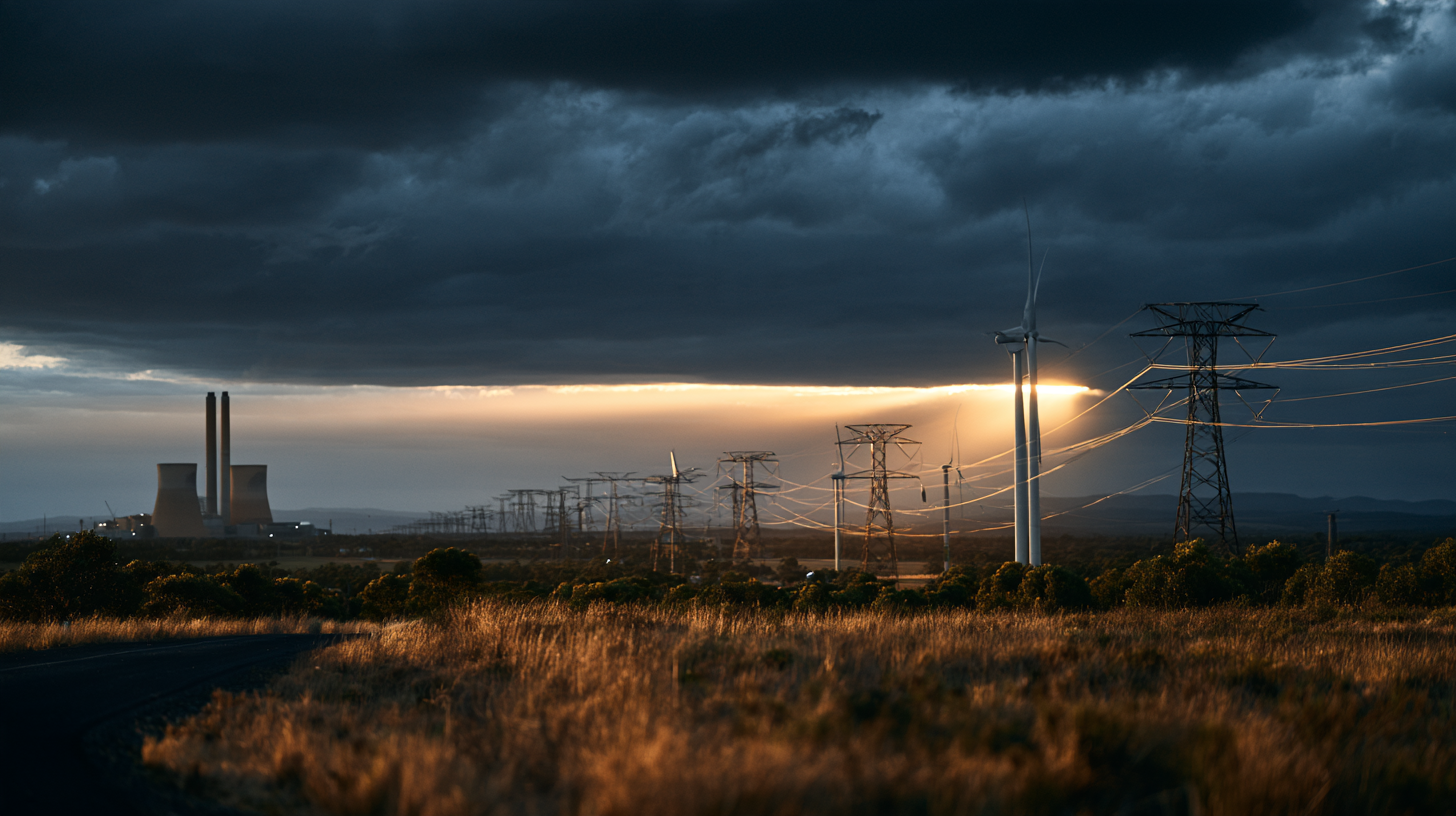
Coal closures, gas restrictions, renewable energy targets and government intervention have reshaped Victoria’s energy future. What evidence supported the decisions, who influenced them, and what has the transition actually delivered?
Victoria committed to an accelerated energy transition before some of the infrastructure needed to deliver it had been secured. Coal closures were negotiated, renewable targets legislated, gas restrictions introduced and public money committed. Yet the Victorian Auditor-General subsequently identified shortcomings in contingency planning, project assumptions and the management of known risks.
In 2016, Victoria voluntarily joined an international coalition of governments committed to accelerating climate action. Successive governments subsequently adopted ambitious emissions-reduction targets and introduced policies affecting electricity generation, household energy choices and public investment.
Meanwhile, a new source of electricity demand — data centres — is expanding as Victoria prepares for the retirement of much of its coal-fired generation.
The central issue is not whether renewable energy can deliver benefits. It is whether governments properly assessed the full costs, practical requirements and consequences of their decisions.
Who set the agenda? What did ministers know? What alternatives were considered? And what will Victorians ultimately pay?
THE COAL CLOSURES WERE KNOWN. THE REPLACEMENTS WERE NOT READY.
Victoria’s electricity system has historically depended heavily on brown coal. Hazelwood closed in 2017. Yallourn is scheduled to close by June 2028, while Loy Yang A is scheduled to close by July 2035.
These closures reflect ageing infrastructure, commercial decisions, environmental policies and agreements between governments and energy companies. They were not unexpected.
In 2021, the Victorian Government negotiated an agreement with EnergyAustralia for Yallourn’s closure. Government-commissioned modelling had already identified a potential firm-energy gap of approximately 1.37 gigawatts during an extended summer peak-demand event.
The modelling assumed that additional renewable generation, storage and transmission infrastructure would help address the risk. But those assumptions depended on projects being delivered.
The Western Renewables Link was originally expected to be operational in 2025. By the Auditor-General’s December 2025 report, its expected completion had shifted to 2029. VNI West, another critical transmission project, was expected to be completed in 2030. Both dates fall after Yallourn’s scheduled closure.
The Auditor-General found that the department had not proposed contingencies for delays to these transmission projects when advising on Yallourn’s closure.
The Government had identified the need for replacement infrastructure, yet critical components are now scheduled to arrive after the coal station retires.
That does not establish electricity shortages are inevitable. Additional batteries, generation and other market developments have improved reliability forecasts. But it raises serious questions about the assumptions supporting the original decisions.
THE AUDITOR-GENERAL’S WARNING
In December 2025, the Victorian Auditor-General published Managing the Transition to Renewable Energy. The audit found that Victoria was on track to achieve its 2025 renewable electricity target, but identified significant risks to future targets.
Major transmission and offshore wind projects were delayed. Planning had not adequately accounted for known uncertainties. Contingency arrangements were insufficient in important areas.
The Government’s own planning arrangements had not adequately resolved some of the risks associated with the transition it was pursuing.
OFFSHORE WIND: THE TARGET WAS SET BEFORE CRITICAL OBSTACLES WERE RESOLVED
Victoria adopted offshore wind targets of 2 gigawatts by 2032, 4 gigawatts by 2035 and 9 gigawatts by 2040. The Government presented offshore wind as a major contributor to replacing coal generation.
But the Auditor-General found that the original targets relied on a single planning scenario that did not adequately account for port requirements.
The Government’s preferred terminal at the Port of Hastings encountered environmental approval difficulties. The Commonwealth rejected the original proposal in January 2024 because of unacceptable impacts on protected wetlands. Victoria subsequently pursued a revised proposal and alternative port arrangements.
The Government delayed its first offshore wind auction. The Auditor-General concluded that Victoria would not meet its 2032 target; even under an optimistic scenario, the first 2 gigawatts would not be completed until the end of 2033.
The audit also reported that estimated offshore wind costs had increased four- to fivefold. That escalation concerns offshore wind estimates, not the total cost of Victoria’s energy transition.
Why were the targets adopted before essential port arrangements, construction requirements and financial assumptions had been adequately resolved? And what revised cost estimates have been presented to Parliament?
THE STORAGE QUESTION
Wind and solar generation cannot be dispatched independently of weather conditions. A reliable electricity system therefore needs sufficient storage, flexible generation, transmission and other supporting services.
In 2022, modelling commissioned by Victoria’s energy department identified requirements for additional long-duration storage by 2032 and 2035. But the Auditor-General subsequently found that Victoria had no committed or anticipated long-duration storage projects capable of meeting those identified requirements.
Long-duration storage projects can take many years to develop. If the need was identified in 2022, why had the required investment not been secured by December 2025?
GLOBAL AMBITIONS, VICTORIAN DECISIONS: WHO SET THE AGENDA?
Victoria’s energy policies did not develop in isolation. International climate agreements, United Nations frameworks and networks of regional governments have encouraged increasingly ambitious emissions-reduction policies.
The Paris Agreement established an international framework for climate action. The United Nations Sustainable Development Goals include commitments relating to clean energy, sustainable infrastructure and climate change.
But there is an important distinction between international influence and domestic legal obligations. Australia is a party to the Paris Agreement. Victoria’s specific renewable electricity targets, gas restrictions and accelerated net-zero timetable were adopted through its own political and legislative processes.
In 2016, Victoria joined the Under2 Coalition. Established in 2015 by California and Baden-Württemberg, it mobilises climate action among states and regions and is supported by the Climate Group. Its memorandum of understanding is not legally binding. Victoria’s participation was voluntary.
Victoria subsequently adopted a net-zero emissions target of 2045, five years ahead of Australia’s national 2050 target, and legislated a 95 per cent renewable electricity target for 2035.
Membership does not prove the coalition directed those decisions. But it establishes a documented relationship warranting scrutiny: which ministers authorised participation, what commitments and advice followed, what alternative pathways were examined, and what financial and reliability assessments preceded legislation?
International cooperation does not remove domestic accountability. Victorian ministers remain responsible for the policies they chose to adopt.
WHO HAD A SEAT AT THE TABLE?
Environmental organisations, renewable energy developers, unions, electricity generators, transmission businesses and industry groups have participated in the policy debate. Their interests are not identical.
Developers seek investment opportunities; transmission businesses have commercial interests in network expansion; unions advocate for employment and industrial outcomes; environmental organisations pursue emissions reductions.
The Labor Environment Action Network has publicly described its objective of influencing Labor’s environmental policy. That establishes an advocacy role, not proof of responsibility for a particular government decision.
Who met with ministers, what recommendations were made, and how were concerns about affordability, reliability and project feasibility treated?
THE STATE ELECTRICITY COMMISSION: FOLLOW THE MONEY
The Andrews Government committed an initial $1 billion to revive the State Electricity Commission as an investor in renewable energy and storage. The Allan Government subsequently launched the SEC’s strategic plan.
At a Victorian parliamentary hearing in November 2025, the SEC chief executive identified commitments of $245 million to the Melbourne Renewable Energy Hub and $370 million to the Horsham project.
The SEC’s 2024–25 annual report recorded a statutory after-tax loss of $6.8 million during its establishment and early investment period. That early loss does not demonstrate that long-term investments will be unsuccessful.
But public investment must be assessed against expected returns, financial risks and measurable outcomes. How much taxpayer money will ultimately be committed, what returns are expected, and what happens if projects underperform?
CHEAPER ELECTRICITY: WHAT DO THE NUMBERS SHOW?
The Essential Services Commission recorded an estimated annual electricity bill of $1,384 for a typical residential customer using 4,000 kilowatt-hours on a standard contract in 2014–15. By 2018–19, published standard-contract estimates had increased substantially.
The Victorian Default Offer, introduced in 2019, established a regulated benchmark. That benchmark rose sharply in 2023–24 before declining in subsequent years.
These are not perfectly consistent twelve-year comparisons: the tariff products and regulatory methodology differ. Actual bills vary by consumption, tariffs, solar generation and retailer arrangements.
Nor can all price movements be attributed to renewable energy policy. Wholesale conditions, fuel prices, network charges, outages and national regulation matter.
If affordability is central to government policy, the test is whether comparable households and businesses have experienced sustainable real-terms savings after accounting for the full costs of reliable supply.
GAS RESTRICTIONS: HOUSEHOLD COSTS AND CHOICE
Victoria has introduced restrictions on new gas connections and further electrification requirements. The Government argues efficient electric appliances can reduce emissions and household running costs.
For many households that may be correct. But installation costs vary. Older homes may need electrical upgrades and new appliances. Some households can recover costs through lower running expenses; others face longer payback periods.
What will electrification actually cost pensioners, renters, low-income households and owners of older homes? And how will the transition affect gas-network costs for those remaining connected?
DATA CENTRES: THE NEW ELECTRICITY DEMAND VICTORIA MUST ACCOUNT FOR
Artificial intelligence, cloud computing and digital infrastructure are driving demand for electricity-intensive data centres, many requiring substantial power supplies around the clock.
In June 2026, AEMO identified data centres as one of the fastest-growing sources of electricity demand. It reported operational Australian data centres accounted for approximately 2 per cent of grid-supplied electricity consumption, with substantial growth projected.
AEMO’s August 2026 Electricity Statement of Opportunities incorporated updated data centre demand forecasts and refined its methodology to account for project uncertainty and gradual increases in consumption. Its national outlook projected electricity consumption increasing by more than 40 per cent over the following decade, partly driven by electrification and data centres.
These are national, not Victorian-only, projections. But they establish that data centres are a material emerging consideration.
Victoria is preparing for coal generation to retire, encouraging electrification and pursuing renewable targets while accommodating potentially substantial additional demand.
Are generation, storage and transmission plans being updated quickly enough to account for new data centres? Who funds connections and network upgrades? Could added demand affect existing consumers? What electricity and water disclosures are required?
AEMO’s forecasts show the issue is considered in national system planning, not that every Victorian project has been adequately assessed or that associated costs have been fairly allocated.
Data centres add another test of whether governments are coordinating development ambitions with the infrastructure needed to support them.
RELIABILITY: THE FORECASTS ARE CONDITIONAL
AEMO’s August 2026 assessment reported an improved electricity reliability outlook, identifying no forecast reliability gaps before 2030 under its central assessment.
But it emphasised continued investment as ageing generators retire and demand increases. It projected substantial growth in consumption and retirement of approximately 15 gigawatts of coal and gas generation nationally over the following decade.
The outlook depends on replacement generation, storage and transmission being delivered; it is not an unconditional guarantee. The Government must show that its timetable is supported by infrastructure that can actually be delivered when needed.
THE COST OF THE ENTIRE SYSTEM
A reliable electricity system cannot be assessed solely by the cost of individual wind farms, solar projects or coal generators. It needs generation, transmission, storage, system-security services and sufficient capacity for difficult conditions.
Some costs are borne by private investors; others through regulated network charges, government expenditure or contracts. They should not be conflated, but should be disclosed.
A low-cost source of generation does not automatically mean a low-cost electricity system. The entire system must be assessed.
TWELVE YEARS OF DECISIONS. WHO IS ACCOUNTABLE?
Victoria has increased renewable generation and attracted investment. But it has also set ambitious targets, negotiated coal closures, restricted some gas connections and invested public money in energy projects.
Its governments voluntarily participated in international climate initiatives and adopted policy timetables through Victorian legislation. Electricity demand is changing, including through data centres.
The Auditor-General documented shortcomings in planning assumptions and contingency arrangements. AEMO identified a pathway to reliable supply, but one dependent on timely investment.
These findings do not establish the transition will fail, nor that retaining ageing coal indefinitely would be cheaper or more reliable. They show why decisions must be examined against evidence rather than ambition.
The central issue is not whether Victoria should have an energy transition. It is whether successive governments adequately planned, costed and managed the transition they chose.
International frameworks did not independently determine Victoria’s timetable. Targets did not build transmission lines. Coal closure agreements did not guarantee replacement capacity. Investment announcements do not establish cheaper bills.
The Government knew coal closures were coming. It knew infrastructure was required. It knew the risks of delay.
After twelve years, the question is not what the Government intended. It is what the Government committed Victoria to, what it has actually delivered, and what the public will be left paying.
PRIMARY SOURCES
Victorian Auditor-General — Managing the Transition to Renewable Energy (2025)
https://www.audit.vic.gov.au/report/managing-transition-renewable-energy
AEMO — 2026 Electricity Statement of Opportunities
https://www.aemo.com.au/energy-systems/electricity/national-electricity-market-nem/nem-forecasting-and-planning/forecasting-and-reliability/nem-electricity-statement-of-opportunities-esoo
AEMO — Digital demand surge (2026)
https://www.aemo.com.au/newsroom/news-updates/digital-demand-surge
Essential Services Commission — Victorian Energy Market Report 2016–17
https://www.esc.vic.gov.au/sites/default/files/documents/victorian-energy-market-report-2016-17-20171121.pdf
Essential Services Commission — Victorian Energy Market Report 2018–19
https://www.esc.vic.gov.au/sites/default/files/documents/VEMR%20annual%20report%202018-19_Final_20191205_0.pdf
Climate Group — Victoria Under2 membership
https://www.theclimategroup.org/under2-coalition/region/victoria
Climate Group — Under2 Memorandum of Understanding
https://www.theclimategroup.org/under2-memorandum-understanding
Climate Group — Under2 history
https://www.theclimategroup.org/history-under2-coalition
State Electricity Commission — Annual Reports
https://www.secvictoria.com.au/about/annual-reports
Editorial note: Historical electricity price benchmarks are not a harmonised, inflation-adjusted 2014–2026 bill series. Membership of international climate networks does not by itself establish causal influence on individual Victorian policy decisions.