
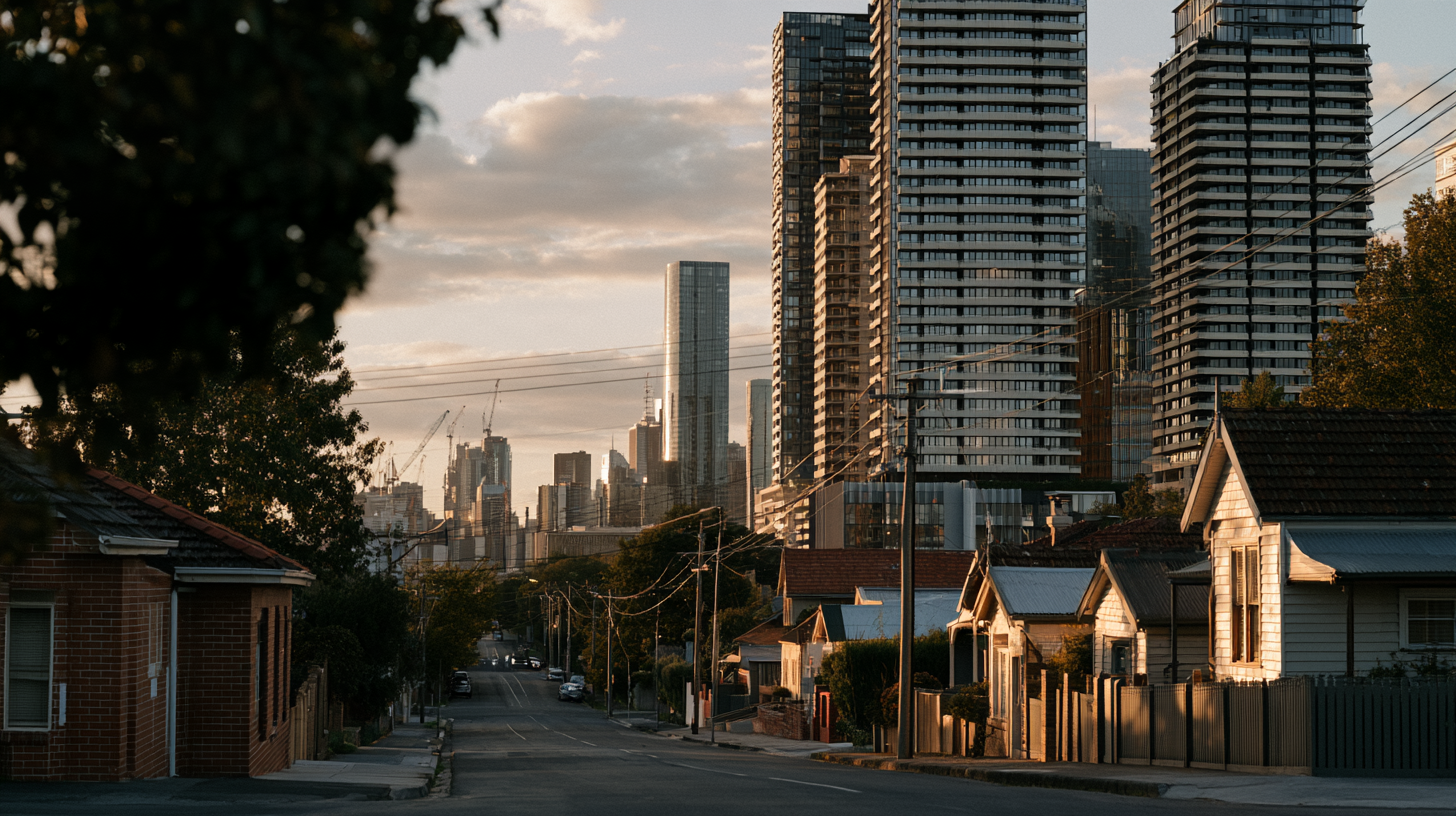
Successive governments welcomed population growth while housing affordability deteriorated and infrastructure struggled to keep pace. Were the consequences foreseeable, and why weren't they addressed?
Victoria's housing crisis did not arrive without warning. More than a decade ago, the State Government was forecasting millions of additional residents and the need for approximately one million more dwellings by 2031. Yet twelve years into Labor government, housing construction remains below its stated ambitions, social-housing demand is substantial, and official audits have exposed serious gaps in planning and financial sustainability.
The warnings were not hidden in obscure research papers.
They were contained in the Government's own population projections, infrastructure assessments and financial reports.
The Andrews, Allan and Carroll governments have controlled Victoria's planning system, state housing programs, property taxation and much of the infrastructure required to support growth.
They did not control every factor influencing housing demand. Commonwealth migration policy, interest rates, construction costs and private investment have all played substantial roles.
But the Victorian Government was responsible for preparing the state for the population growth it expected.
The evidence raises a difficult question: if the Government knew how much Victoria was likely to grow, why was the housing system still struggling to keep pace?
THE GOVERNMENT KNEW WHAT WAS COMING
In 2014, Victoria's official population projections anticipated that the state would reach approximately 7.7 million residents by 2031.
The same projections anticipated approximately 3.33 million dwellings, compared with around 2.33 million in 2011.
That represented a projected increase of approximately one million dwellings over twenty years.
The Government was therefore working with a planning scenario requiring an average increase of around 50,000 dwellings annually.
These were projections, not guarantees. They depended on assumptions about migration, births, deaths, household formation and development.
But they established the scale of the challenge confronting policymakers.
By March 2026, Victoria's population had reached approximately 7.15 million, an increase of around 1.31 million since June 2014.
The growth was substantial.
It was also consistent with the long-established expectation that Victoria would continue attracting large numbers of residents.
The Government's own planning framework recognises population projections as essential inputs for land use, housing and infrastructure decisions.
Victoria was not planning in the dark. Its governments had access to the information needed to anticipate future demand.
The question is whether their decisions matched that knowledge.
THE 800,000-HOME PROMISE: THE NUMBERS DON'T ADD UP
In September 2023, the Andrews Government announced its Housing Statement, including a target of 800,000 net additional homes over ten years.
That requires an average of 80,000 net new homes annually.
But setting a target is not the same as creating the capacity to achieve it.
In its assessment two years after the Housing Statement, the Municipal Association of Victoria found that quarterly dwelling completions had averaged approximately 14,461 during the early period of the target.
To reach 800,000 homes by June 2034, that rate would need to rise to approximately 20,460 dwellings per quarter.
The Association described the required pace as unprecedented.
Victoria has continued constructing substantial numbers of dwellings, and its gross completions have compared favourably with other states in absolute terms.
But absolute construction totals do not establish whether supply is keeping pace with Victoria's population growth or its own net housing target.
Demolitions and replacement dwellings must also be considered.
The Government's challenge is not simply to build more than other states.
It is to build enough additional homes to meet Victoria's needs.
Why did the Government announce a target requiring an unprecedented construction rate before demonstrating that the industry could deliver it?
THE AUDITOR-GENERAL'S FINDING: HOUSING DEMAND WAS UNDERSTOOD. THE PLANS WERE INCOMPLETE.
In June 2024, the Victorian Auditor-General examined Homes Victoria's planning and delivery of social housing.
Its findings exposed a problem far more serious than a missed construction target.
Homes Victoria understood the demand for social housing, the condition of its assets and its financial position.
But the Auditor-General found that it lacked a plan to direct new housing towards areas with the greatest demand.
It also lacked a financial sustainability plan.
This was not a finding that the agency had no housing strategy whatsoever. It had strategic documents and project assessment processes.
The problem was that those arrangements did not adequately establish how housing supply would be prioritised against statewide need or how the public-housing system would remain financially sustainable.
In May 2023, the Government had directed Homes Victoria to develop a financial sustainability plan for consideration that September.
By the June 2024 audit, the plan remained incomplete.
The agency responsible for managing Victoria's public-housing system understood the demand and the financial pressures. Yet key plans required to address those pressures were still missing.
That is a documented failure of planning and governance.
And it raises an obvious question about ministerial oversight.
What action was taken when the September 2023 deadline was missed?
A $275 MILLION ANNUAL RENEWAL GAP
The Auditor-General also documented the financial pressures confronting Victoria's existing public-housing portfolio.
Homes Victoria estimated annual capital expenditure requirements of approximately $350 million to renew and replace ageing assets.
It received around $75 million annually in Victorian Government capital funding.
The resulting renewal funding gap was approximately $275 million a year.
The audit also found that maintenance costs were growing at twice the rate of rental income.
This matters because Victoria's housing challenge is not limited to constructing additional dwellings.
The Government must also maintain the homes it already owns.
Ageing housing requires repairs, upgrades and replacement.
If renewal investment does not keep pace with deterioration, the state risks losing usable housing capacity even while announcing new construction programs.
What is the value of promising thousands of new homes if the existing public-housing system cannot be sustainably maintained?
The Auditor-General's findings make clear that long-term housing provision requires more than capital announcements.
It requires an adequately funded, financially sustainable system.
$5.3 BILLION ANNOUNCED. ONE-FIFTH OF HOMES DELAYED.
In 2020, the Andrews Government announced the $5.3 billion Big Housing Build.
The program aimed to deliver 12,949 dwellings across social, affordable and private housing categories.
The Auditor-General's June 2024 assessment found that approximately 80 per cent were expected to be completed by December 2026.
The remaining 20 per cent were expected to be delayed until 2028–29.
Planning difficulties, labour shortages, material costs and COVID disruptions contributed to the delays.
The audit also found that the program was on track to remain within its original $5.3 billion budget.
That finding must be acknowledged.
But financial compliance does not eliminate the consequences of delayed delivery.
For households experiencing homelessness, family violence or unsuitable accommodation, a home completed three years late is not a home available when needed.
The program also includes replacement dwellings and housing outside the social-housing category.
Consequently, its total construction figure cannot be treated as an equivalent net increase in social housing.
The proper test is how many additional suitable homes become available, where they are located and whether they reduce unmet demand.
BUILDING HOMES WHILE LOSING HOMES
Victoria's social-housing figures illustrate why gross construction announcements can be misleading.
Infrastructure Victoria reported that almost 3,000 social homes were built during 2023–24.
During the same period, more than 1,600 existing social homes were divested through sales, transfers or demolition.
Not every divestment represents a permanent loss of social housing.
Some properties are replaced through redevelopment, while transfers can change ownership or management without removing a dwelling from the sector.
Nevertheless, the figures demonstrate why net additions matter.
A government can announce thousands of newly built dwellings while achieving a much smaller increase in the total number available.
In its infrastructure strategy, Infrastructure Victoria recommended building 60,000 additional social homes over fifteen years.
It estimated that this would require between $12 billion and $19.5 billion in Victorian Government funding, depending on land arrangements and Commonwealth contributions.
That recommendation illustrates the scale of the longer-term task.
Victoria needs a sustained increase in social-housing supply, not simply a succession of construction announcements.
TENS OF THOUSANDS WAITING
In September 2026, the Victorian Housing Register recorded 57,604 new applications for social housing.
Of those, 32,947 were priority applications.
Another 11,305 applications came from existing social-housing tenants seeking transfers, including 7,859 priority transfers.
Combined, the priority categories totalled 40,806 applications.
These figures are applications, not a count of individual homeless people. Transfer applications must also be distinguished from applications for new housing.
But the scale of demand is unmistakable.
The Government has invested in additional social housing, yet the register continues to reveal substantial unmet or changing housing needs.
The accountability question is whether the number of suitable homes becoming available is sufficient to make meaningful progress against that demand.
TAXING PROPERTY WHILE RELYING ON PRIVATE INVESTMENT
Victoria's approach to property taxation introduces another potential conflict between government objectives.
In May 2023, the Government announced changes to land tax as part of its COVID Debt Repayment Plan.
From January 2024, the general land-tax threshold was reduced from $300,000 to $50,000.
This brought additional investment properties within the land-tax system.
The policy was designed to raise revenue.
But Victoria also relies on private investors to finance rental housing and support new residential development.
Research published by PropTrack in October 2024 estimated that approximately 4,900 more Victorian investment properties had been sold following the land-tax announcement than would otherwise have been expected under its statistical model.
The research compared Victorian investor sales with trends in New South Wales and Queensland.
The estimate is not a direct count of homes permanently removed from the rental market.
Some properties may have been purchased by other investors. Others may have become owner-occupied homes.
PropTrack also acknowledged differences in housing-market conditions between states.
Nevertheless, the analysis identified a statistically significant increase in investment-property sales associated with the tax changes.
This raises a legitimate policy question.
Did the Government adequately assess the effect of increased property taxation on investment decisions, rental availability and future housing construction before implementing the changes?
Tax policy can serve legitimate revenue and equity objectives.
But those objectives should be assessed against the Government's simultaneous need to increase housing supply.
THE GOVERNMENT WANTED MORE HOMES. COULD THE INDUSTRY BUILD THEM?
Victoria's housing targets also depend on construction capacity.
Building more homes requires skilled labour, available land, development finance, building materials, infrastructure and commercially viable projects.
Yet Victoria has simultaneously pursued a large program of public infrastructure construction.
Rail, road and other major projects draw on parts of the same labour market and construction supply chains.
The extent of that competition varies by trade and project type, and it would be misleading to assume every infrastructure worker could otherwise be building homes.
Nevertheless, governments must consider industry capacity when setting expenditure and construction priorities.
Victoria's residential building industry has also faced higher interest rates, escalating costs and business failures.
These pressures have affected other states as well.
But their existence makes credible planning more important, not less.
What assessment did the Government undertake of the workforce, financing and construction capacity required to deliver 80,000 additional homes annually?
And what evidence demonstrated that the target was achievable?
THE POPULATION FORECASTS ALSO IDENTIFIED WHERE GROWTH WOULD OCCUR
Victoria's population projections did not merely forecast statewide growth.
They identified the locations expected to experience the greatest increases.
The Government's 2023 projections anticipated substantial growth in municipalities including Wyndham, Melton, Casey, Hume and Whittlesea.
These projections were intended to inform land-use decisions, infrastructure investment and service planning.
That matters because housing cannot be separated from the infrastructure required to support it.
New suburbs need transport, schools, healthcare, water, electricity and community services.
Higher-density established suburbs need existing networks capable of accommodating additional demand.
If homes are constructed without adequate infrastructure, the consequences are transferred to residents through longer journeys, congestion and pressure on services.
The question is not simply whether governments knew Victoria would grow. It is whether they acted sufficiently early in the places where that growth was expected.
WHO MADE THE DECISIONS?
The responsibility for Victoria's housing position is shared, but it is not impossible to identify.
The Commonwealth controls national migration policy and influences housing through taxation, finance and funding programs.
Local councils exercise planning functions within the state framework.
Developers, lenders and builders determine whether many private projects proceed.
But Victoria's successive Labor governments controlled state planning legislation, major housing programs, property taxation and significant infrastructure expenditure.
The Andrews Government presided over much of the population growth before COVID, introduced the Big Housing Build and announced the 800,000-home target.
The Allan Government inherited and continued those commitments, alongside planning reforms intended to accelerate development.
The Carroll Government now inherits the consequences and responsibility for ongoing delivery.
A change of Premier does not erase the obligations of government.
Nor does the existence of external economic pressures explain away documented shortcomings in state planning.
The Auditor-General's findings establish that Homes Victoria understood the demand for social housing while lacking key plans to prioritise investment and address financial sustainability.
The official population projections establish that substantial growth was anticipated well in advance.
And the Government's own housing target requires construction to increase dramatically.
Taken together, these findings raise serious questions about the relationship between government forecasts, policy decisions and delivery.
TWELVE YEARS OF GROWTH. WHERE IS THE ACCOUNTABILITY?
Victoria has added approximately 1.3 million residents since 2014.
Its governments have had access to detailed projections of population growth and housing requirements.
They have announced substantial housing investments, introduced planning reforms and established ambitious construction targets.
Those measures should be assessed fairly against the homes they ultimately deliver.
But announcements are not outcomes.
The Government must explain why social-housing planning and financial sustainability remained inadequate when the Auditor-General examined them in 2024.
It must demonstrate that its housing targets are supported by realistic assessments of construction capacity.
It must account for the consequences of property taxation and planning decisions.
And it must show that housing and infrastructure delivery are keeping pace with the communities expected to depend on them.
The most consequential question is not whether Victoria needed more housing. Governments knew it did.
The question is why the state's response has left such a substantial gap between projected need, policy ambition and completed homes.
After twelve years, Victorians are entitled to examine the decisions, the warnings, the delays and the measurable results.
The population growth was foreseeable. The housing requirement was foreseeable. The infrastructure pressures were foreseeable.
The remaining question is whether the governments responsible acted on that knowledge with sufficient urgency, discipline and accountability.
Investigation 02 of 06 — SUNA | More Tax. More Debt. What Did Victoria Get?
Primary-source references
Victoria in Future — official projections
https://www.planning.vic.gov.au/guides-and-resources/Data-spatial-and-insights/discover-and-access-planning-open-data/victoria-in-future
Victorian Auditor-General — Planning Social Housing
https://www.audit.vic.gov.au/report/planning_social_housing
Municipal Association of Victoria — Housing Statement: Two Years On
https://www.mav.asn.au/__data/assets/pdf_file/0006/43278/Sector-brief-Victorias-Housing-Statement-Two-Years-On.pdf
PropTrack — Victorian investor sales following land-tax changes
https://www.proptrack.com.au/insights-hub/how-many-victorian-investors-have-sold-due-to-higher-land-taxes/
Infrastructure Victoria — Build More Social Homes
https://www.infrastructurevictoria.com.au/infrastructure-strategy/recommendations/build-more-social-homes
Victorian Housing Register
https://www.homes.vic.gov.au/applications-victorian-housing-register-vhr
Editorial status: Working draft. Final date-specific verification and legal review recommended before publication.