
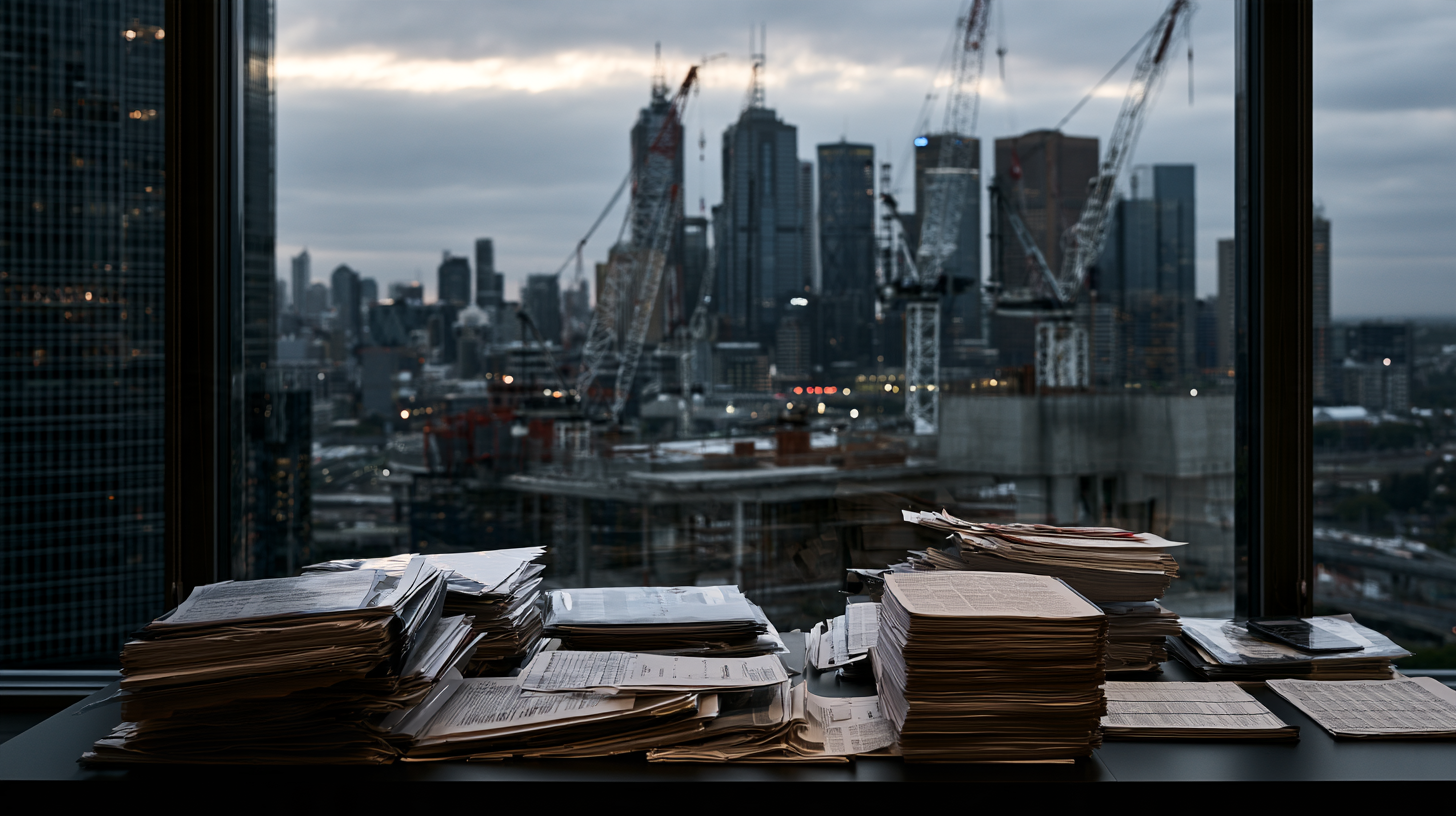
Twelve years of rising taxes, escalating debt and major infrastructure spending. Who approved the commitments, who benefited from the contracts, and what will Victorians be paying for decades to come?
Victoria is heading towards $200 billion in net debt. But the most damning evidence of how the state reached this position is not found in political speeches. It is buried in the government's own financial records and the findings of its independent Auditor-General.
The records reveal a government approving billions in additional infrastructure funding without clearly informing the public, proceeding with major commitments despite repeated affordability warnings, and entering long-term commercial arrangements whose costs extend well beyond construction.
They also reveal hundreds of millions spent on a Commonwealth Games that never took place, and systemic weaknesses in how the public is informed about major project expenditure.
These are not allegations made by political opponents. They are findings contained in official government audits.
And they raise a question successive Labor governments have yet to satisfactorily answer: How much of Victoria's financial burden was unavoidable investment, and how much resulted from decisions that should have been challenged, reconsidered or never approved?
$11.5 BILLION APPROVED. THE PUBLIC WASN'T TOLD.
In December 2023, the Allan Government approved an additional $11.5 billion in state funding for the Suburban Rail Loop.
It did not publicly announce the decision or clearly disclose the additional commitment in the Budget papers. The Victorian Auditor-General confirmed this in August 2026.
The audit also established that Treasury and the Department of Premier and Cabinet had consistently advised governments since 2019 that the project could not be fully funded from the state Budget without limiting other expenditure and missing fiscal targets.
This is a remarkable sequence of events. Senior departments warned of serious affordability problems. The Government proceeded. An additional $11.5 billion was approved. And the public was not clearly informed at the time.
By June 2026, the first stage of the project, SRL East, still faced a $5.5 billion gap in approved funding.
The Government had assumed an $11.5 billion Commonwealth contribution without securing that commitment. The Commonwealth had approved $6 billion.
The Auditor-General warned that additional state borrowing or new revenue measures might be required.
But the funding concerns extended further. The audit found that a rail improvement charge on public transport fares had already been raising revenue for more than a year without being transparently disclosed to commuters.
Victorians were helping finance the project through their fares without that charge being clearly identified.
How can taxpayers properly scrutinise a multibillion-dollar project when major funding decisions and revenue measures are not clearly disclosed?
THE WEST GATE TUNNEL: THE PRICE WASN'T JUST THE CONSTRUCTION BILL
The West Gate Tunnel was initially promoted as a $5.5 billion project. Its reported cost ultimately reached approximately $10.2 billion.
But focusing exclusively on construction costs overlooks another important aspect of the agreement.
In December 2017, the Andrews Government awarded the project to Transurban under a public-private partnership.
The financing arrangements included extending Transurban's existing CityLink tolling rights by ten years, to June 2045, and granting tolling rights over the new tunnel.
In 2019, the Victorian Auditor-General examined the project's development and business case.
The audit identified weaknesses in the assessment of alternatives, the justification for including Monash Freeway works and the transparency of the cost-benefit analysis.
The Auditor-General found that Transurban's ability to access and extend existing toll revenue was central to the proposal being assessed as unique.
This raises a fundamental question. Was the Government selecting the best infrastructure solution for Victorians, or was the financing structure itself driving the decision?
Transurban was entitled to pursue a commercially advantageous agreement. The Government's responsibility was different.
It was required to protect the public interest, demonstrate value for money and properly assess alternatives.
A completed tunnel may deliver real transport benefits. But those benefits must be weighed against the construction costs, the Government's contributions and the value of the tolling rights granted to its private partner.
The full price of infrastructure cannot always be found in the construction budget. Sometimes it is paid over decades.
THE COMMONWEALTH GAMES: A FAILURE WITH A $589 MILLION PRICE TAG
The Commonwealth Games cancellation provides one of the clearest examples of the consequences of inadequate financial planning.
In 2022, the Andrews Government committed to hosting the 2026 Games in regional Victoria. In July 2023, it withdrew.
The Victorian Auditor-General subsequently calculated that bidding for, planning and withdrawing from the Games had cost more than $589 million, with no discernible benefit.
The audit identified an inadequate business case, unrealistic original budgeting and failures in the provision of timely, frank advice.
It also found that the $6.9 billion cost estimate publicly used to explain the cancellation was overstated.
That last finding is especially significant. The original budget was unrealistic. But the figure presented to justify withdrawal was also overstated.
The public was left with a failed commitment, a substantial financial loss and serious questions about the reliability of the information used to explain both decisions.
Of the total cost, $380 million went towards settling the cancellation of the hosting agreement.
More than half a billion dollars was committed to an event that never happened. The Auditor-General found no discernible benefit.
This was a failure of public decision-making with a measurable financial consequence.
THE PUBLIC GETS LESS INFORMATION THAN THE GOVERNMENT
In March 2026, the Auditor-General examined reporting on 110 major Victorian projects with a combined estimated investment of $149.33 billion.
Its findings exposed a broader transparency problem.
Government agencies maintained detailed internal reporting on project risks, delays, costs and changes. Treasury also provided comprehensive quarterly advice to ministers.
But public reporting did not provide the same level of information.
Across 89 projects with comparable records, estimated costs had increased by a net $11.31 billion from their original reported estimates.
Some projects had increased substantially; others had decreased. The net figure must not be mistaken for a measure of waste.
Nevertheless, the scale of the changes makes transparent reporting essential.
The Auditor-General found that the information publicly available did not consistently allow Parliament and the community to properly assess major project performance.
The people approving expenditure had access to detailed information. The people financing that expenditure did not receive equivalent transparency.
This is not merely a communications problem. It goes to the heart of democratic accountability.
THE BILL ARRIVES LONG AFTER THE DECISIONS
Victoria's general government net debt stood at $21.2 billion in June 2014.
The 2026–27 Budget estimated it would reach $165.3 billion by June 2026 and forecast $199.3 billion by June 2030.
Over the same period, the state's taxation revenue has grown substantially. And interest expenses have become an increasingly significant claim on public finances.
The Government can point to new infrastructure and argue that borrowing has supported Victoria's growing population. That argument deserves examination on its merits.
But it does not excuse inadequate planning, opaque financial decisions or failures to disclose significant commitments.
Nor does it answer why government departments' affordability warnings were not sufficient to prevent further commitments without a secure funding strategy.
The people who authorised those decisions will not personally bear the state's long-term debt obligations. Future taxpayers will.
WHO IS ANSWERING FOR THE DECISIONS?
Victoria's financial position cannot be explained by one project, one minister or one economic shock.
But the documentary evidence establishes recurring concerns across successive decisions: inadequate business cases, funding uncertainty, insufficient public disclosure and significant financial consequences.
The Auditor-General has repeatedly provided Parliament with evidence of these problems.
The outstanding question is what accountability has followed.
Were the responsible decision-makers required to explain their actions? Were procurement and project approval practices materially changed? Were recommendations implemented? And what safeguards now prevent the same problems recurring?
A government should not be judged solely by the scale of its investment. It should be judged by the quality of its decisions, the integrity of its financial management and the value delivered to the public.
Victoria has borrowed billions, collected billions more in taxes and committed future generations to substantial financial obligations.
The Government can show Victorians what it built. Now it must explain what it approved, what it concealed from clear public scrutiny, what went wrong and why taxpayers are left carrying the cost.
Investigation 01 of 06 — SUNA | More Tax. More Debt. What Did Victoria Get?
EDITORIAL STATUS: Working draft — source verification and legal review required before publication.
PRIMARY SOURCE LINKS
https://www.audit.vic.gov.au/report/delivering-suburban-rail-loop
https://www.audit.vic.gov.au/report/market-led-proposals
https://www.audit.vic.gov.au/report/withdrawal-2026-commonwealth-games
https://www.audit.vic.gov.au/report/major-projects-performance-reporting-2025
https://www.budget.vic.gov.au/sustaining-victorias-economic-growth